
Birds in the Mosaics of the Land of Israel
Birds are among the most prominent, diverse, and richly represented motifs in the mosaics of the Land of Israel from the Roman and Byzantine periods. This study systematically identifies the bird species depicted in the mosaics, examines their diversity and distribution, and analyzes the contexts in which they appear. Identifying the species and analyzing their representations make it possible to examine the place of birds in human life during the Roman and Byzantine periods and their contribution to our understanding of the natural environment, agriculture, the history of domestication, animal exploitation, and interregional connections.
Scope and Research Method
As part of the study, hundreds of mosaics from the Roman and Byzantine periods in the Land of Israel and other regions of the Mediterranean world were surveyed, including assemblages re-examined specifically for evidence of bird representations. Forty-eight different birds were identified at 61 mosaic sites in the Land of Israel, most to the species level and a minority to the genus level. The data are updated through 2026. In addition, a small number of bird-like representations identified only at the family or order level were recorded but were not included in the count.
The identifications are based on morphological analysis of the birds’ representations, including body structure, posture, bill shape, plumage patterns, and coloration. They also take into account geographical distribution in the Land of Israel and adjacent regions, ecological and behavioral characteristics, and comparisons with modern species. Where identification to species level was not possible, the bird was assigned to the most appropriate genus or broader taxonomic group.
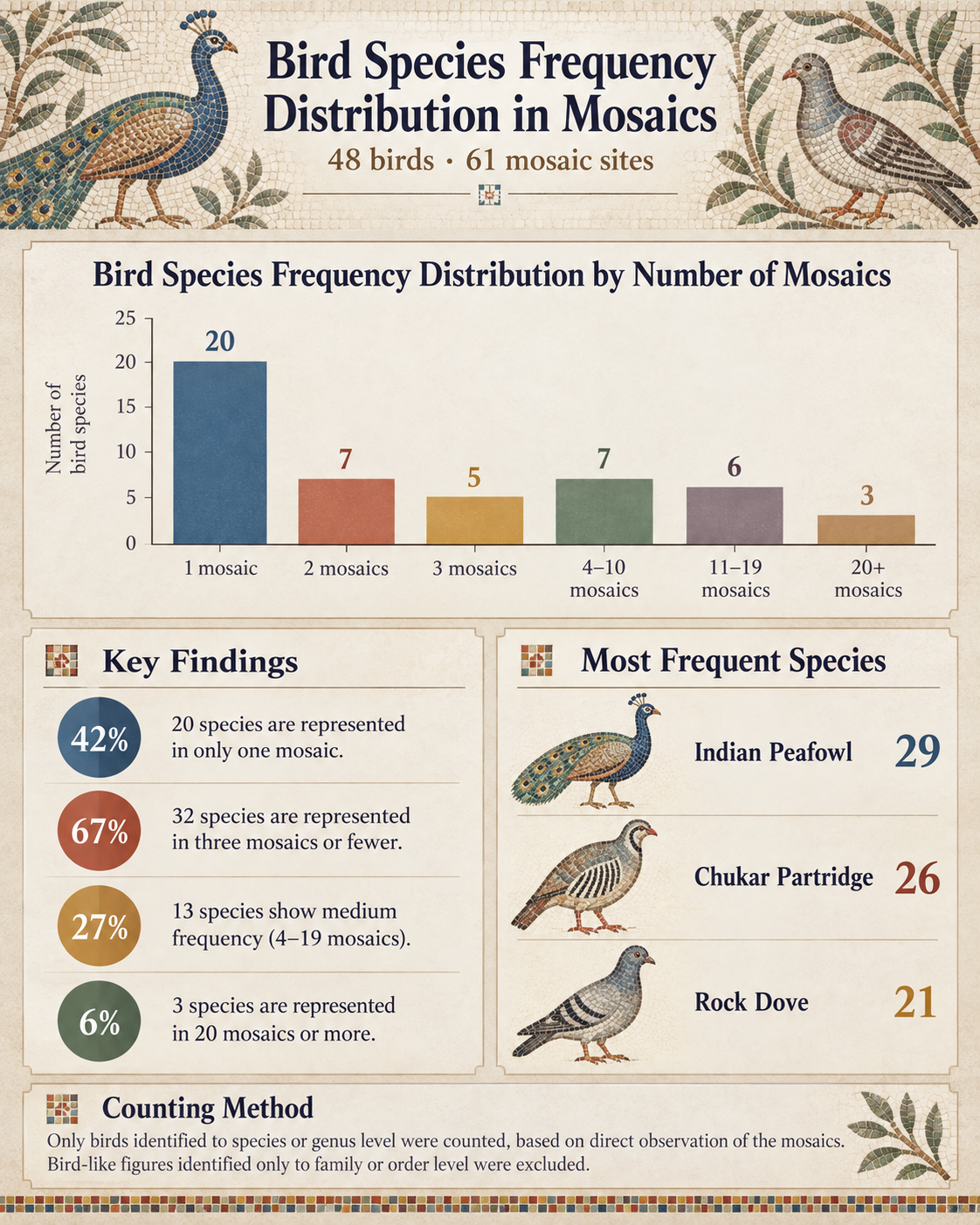
Frequency Distribution of Bird Species in Mosaics
An analysis of the frequency of bird species in the mosaics of the Land of Israel shows that their distribution is uneven. Of the 48 birds identified in the study, 20 (42%) occur at only one mosaic site, seven occur at two mosaic sites, and five are documented at three. Thus, 32 birds (67%) are documented at no more than three mosaic sites.
By contrast, seven birds occur at 4–10 mosaic sites, six at 11–19 sites, and only three species—Indian Peafowl, Chukar Partridge, and Rock Dove—are documented at 20 mosaic sites or more. These figures show that only a small group recurs across numerous mosaic sites, whereas most birds are represented at only a limited number of sites.
Classification of Birds into Research Groups
For the purposes of the discussion, the birds depicted in the mosaics were divided into several basic research groups according to their relationship with humans and the context in which they appear: domesticated birds and wild birds captured and exploited for human use; songbirds and local resident birds; waterbirds and migratory birds; diurnal raptors used in falconry and birds depicted in hunting contexts; and birds in Nilotic contexts.
The classification follows scientific taxonomy for the identification and categorization of species, while its primary purpose is ecological and cultural. The study examines birds in relation to their habitats, their association with humans, and the ways in which they were exploited. Accordingly, some species belong simultaneously to more than one functional category, reflecting the multiple roles they played in the human environment represented in the mosaics and their principal relationship to human activity.
Domesticated species were also raised and consumed for food. The mosaics thus reflect the wide range of uses made of birds: for food, trade, hunting, entertainment, prestige, and the display of their owners’ wealth and achievements.

Zoological Accuracy and Species Identification
In many cases, the birds are depicted with a high degree of zoological accuracy. The representations preserve diagnostic features such as body shape, plumage patterns, bill form, coloration, and characteristic posture, allowing identification to species or genus level. Where such features are absent or insufficiently clear, the identification remains at a broader taxonomic level.
However, the degree of accuracy is not uniform. Some figures were rendered with a limited number of tesserae and colors and were subsequently damaged over the years; in mosaics that were relocated or restored, it is sometimes difficult to distinguish the original sections from later restorations. Identification therefore relies primarily on the preserved original sections, and the degree of certainty for each identification is determined by the state of preservation, the quality of the documentation, and the extent to which the available evidence can be cross-checked.
Despite these limitations, only a small number of figures could not be identified to the species or genus level.
Behavioral Representations of Birds
The accurate identification of the bird species represented in the mosaics also makes it possible to examine their behavior. These depictions preserve aspects of natural behavior—such as posture, movement, feeding, flocking, predation, and interaction with other birds—as well as behavior shaped by human intervention. The mosaics thus attest both to the species that were known and to the ways in which their characteristic behavior was observed.
Direct Observation of the Living World
The accuracy of the bird representations indicates that the birds depicted in the mosaics were based on direct observation of the living world—in nature, in agricultural environments, in households, in captivity, or among hunted birds. Close observation of living birds and birds held or captured by people made it possible to reproduce body structure, plumage patterns, coloration, posture, and other diagnostic features with considerable precision.
The budget available to the mosaic patrons determined the skill of the artisans, the quality of the raw materials, the range of tessera colors, and the size and density of the tesserae. The higher the resolution of the mosaic, the more accurately the diagnostic characteristics of each species could be rendered.
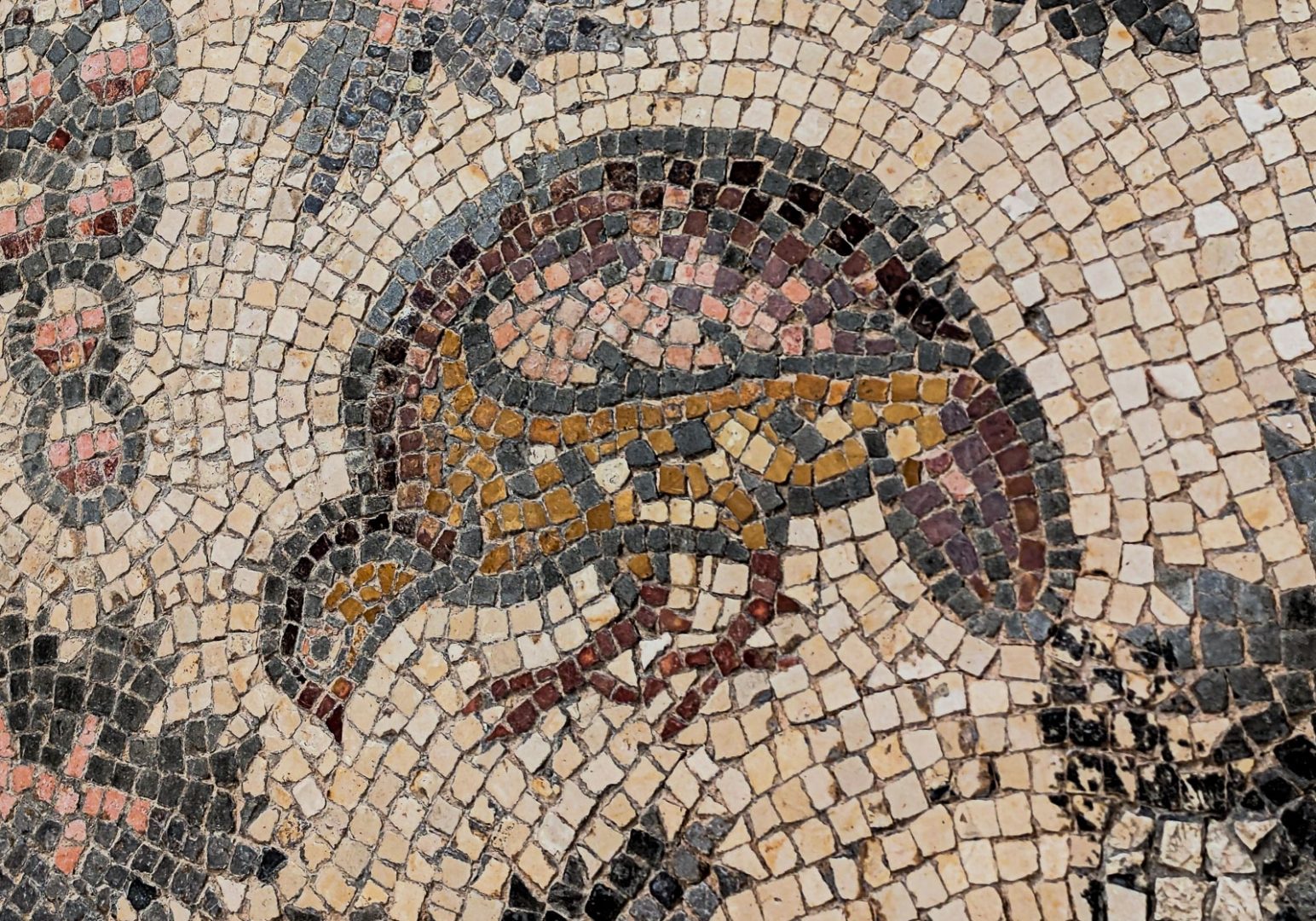
Bird Postures in Mosaics: Standing and in Flight
Birds in the mosaics of the Land of Israel are depicted almost invariably standing or walking. The only exception identified in the Land of Israel so far (2026) is the mosaic of the Nahariya church, where three birds are shown in flight in a unique depiction: two Rock Doves and a female Eurasian Blackcap. Outside the Land of Israel as well, depictions of birds in flight are extremely rare, and this study identified only a few examples in mosaics of the same periods from across the Mediterranean basin.
It is important to note that whenever birds are depicted in flight, the scene is almost always related to hunting, in two principal contexts. In falconry hunting scenes, which have not yet been identified in the Land of Israel, raptors are shown in flight, and sometimes waterfowl are depicted fleeing from them. In limestick-hunting scenes, a stationary raptor could provoke different responses according to the circumstances: some birds could freeze and remain on branches in response to the predator, while others could approach and mob it; birds could also be flushed from trees and flee the hunting area. In the Nahariya mosaic, the raptor is interpreted here as a taxidermied bird, used as a deliberately stationary hunting aid within a system that could exploit freezing and mobbing responses according to opportunity. In the Land of Israel, a depiction of limestick hunting is currently known only from the mosaic of the Nahariya church.
The predominant and consistent pattern of depicting birds in standing poses makes it possible to show clearly the structure of the body, bill, legs, and plumage patterns, and thus to identify the species. These representations also reflect conditions of observation in the ancient world: birds that were standing, walking, being held, or being hunted could be observed closely and examined in detail, whereas birds in flight were more distant and more difficult to identify and depict accurately. In addition, some species share similar features and diagnostic characteristics, making the identification of a small bird in flight difficult even in nature, and certainly more difficult for a viewer looking at a mosaic floor.
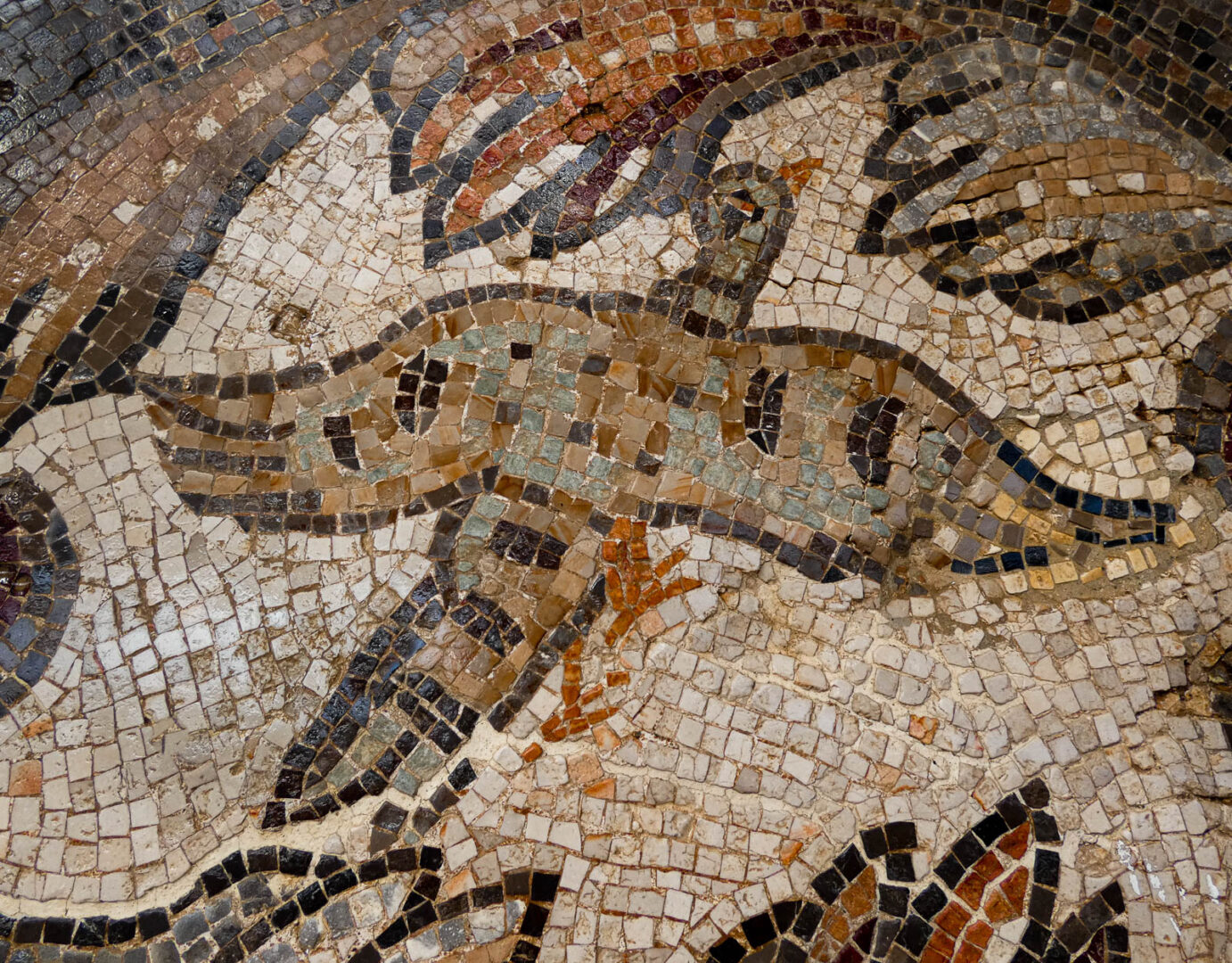
The depiction of flight at Nahariya is therefore especially striking. These birds are an integral part of the hunting scene: some of the birds are shown standing, while others are startled and flee the hunting area in the orchards. The mosaic thus gains a sense of movement that is almost unknown in mosaics of the period. Even in flight, the artist preserved the female blackcap’s distinctive identifying feature—its brown-rufous cap—and thus maintained the identification of the species even in the most difficult posture to depict.
Diurnal raptors standing with their wings spread are a familiar image in the art of the period, as in the Roman eagle. In the mosaics of the Land of Israel, some of these raptors bear a collar and bell indicating ownership and training, and their posture reflects the stance of trained falconry birds on a dedicated perch, as seen, for example, in the raptor standing on a sphere in the mosaic from the church of Khirbat al-Fula in the Jordan Valley. While perched, a raptor may spread its wings to stabilize its body or in an attempt to take flight.
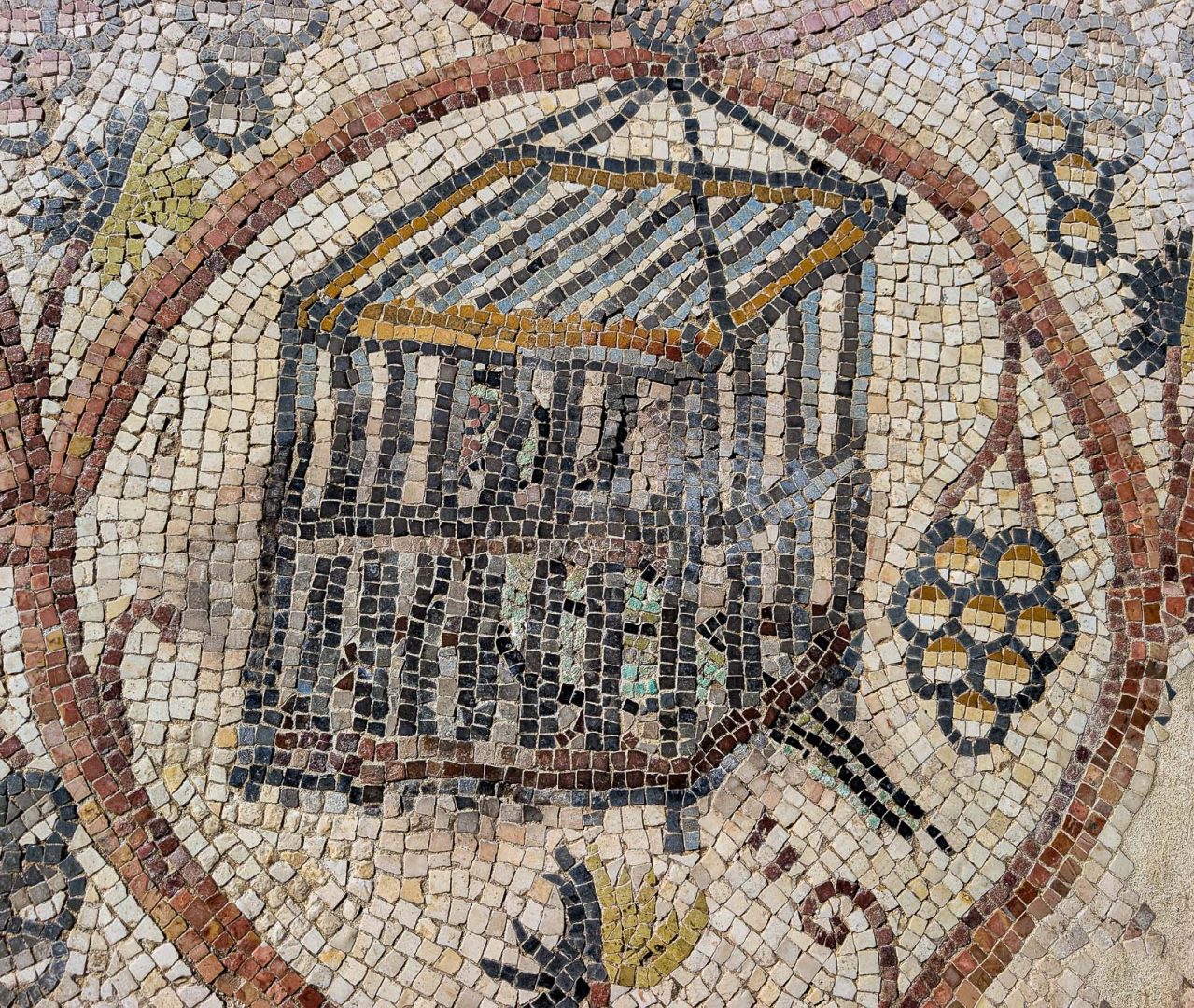
Bird Cages: Their Uses and Economic Significance
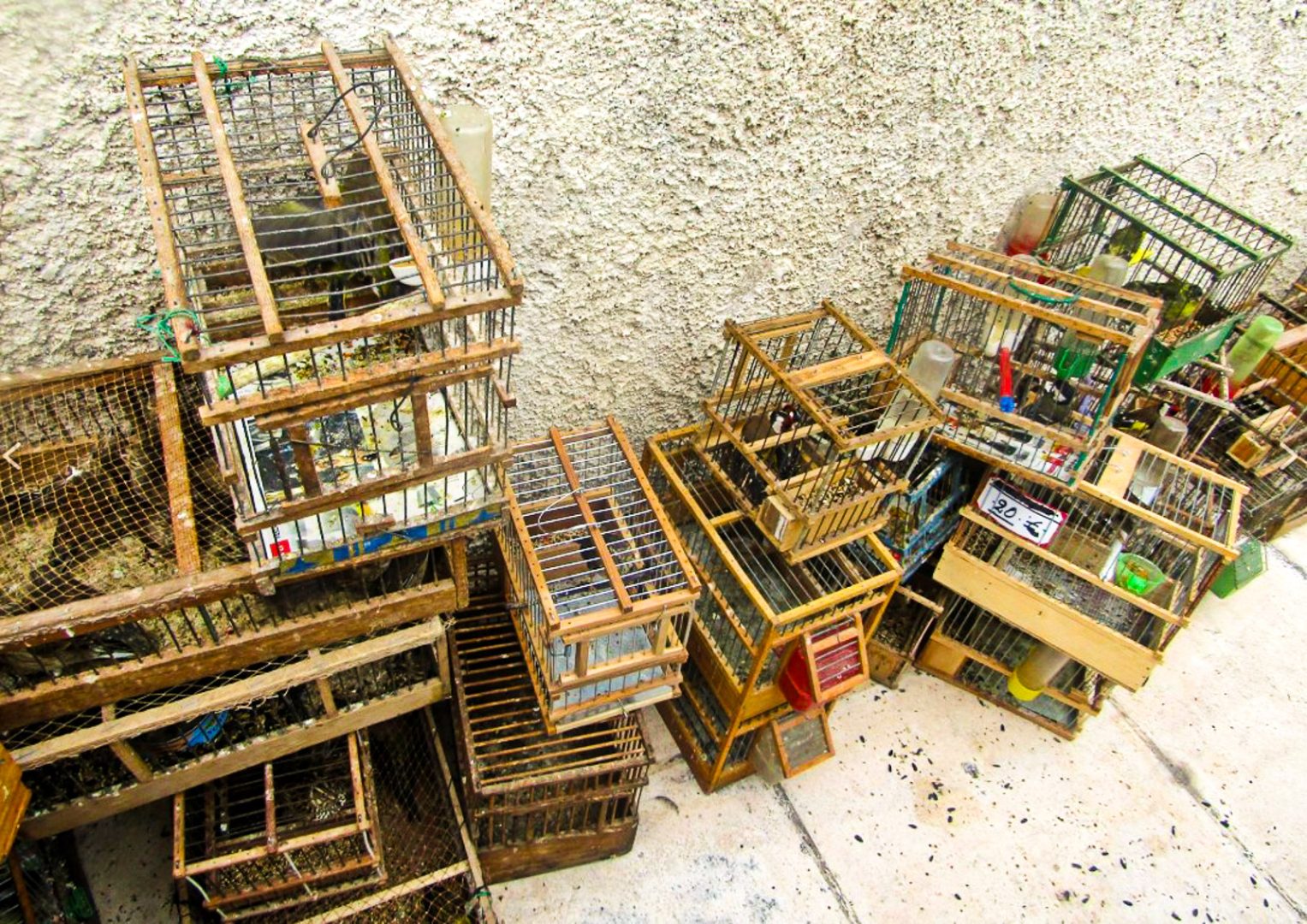
Bird cages appear in several mosaics from the Land of Israel and in a variety of functional contexts. In the church at Beer Shema, a pheasant is depicted in a cage, providing evidence for the transport of domesticated birds and their display for sale. In the synagogue at Ma'on–Nirim, a migratory quail is shown in a cage, while the Armenian Bird Mosaic in Jerusalem depicts a Chukar Partridge in a cage. In the Nahariya mosaic, empty cages with open doors are shown opposite a Hooded Crow and a Common Blackbird facing the cage entrances, moments before capture. In the Samaritan mosaic from Samara, an empty cage is depicted with a water vessel attached to its front. The Samaritans' avoidance of human and animal figures, in accordance with their interpretation of the Second Commandment, gave the water vessel a visual function that clarifies that the cage was used for capturing birds and for keeping or transporting them. As part of the broader corpus of agricultural and economic scenes in the mosaics, depictions of cages also served to present the economic world of the site's inhabitants, the professional knowledge available to them, and the agricultural and commercial abundance they wished to display.
Sexual Dimorphism
In many species, pronounced sexual dimorphism is evident, and this phenomenon is also reflected in the mosaics. Males and females can be distinguished by plumage coloration, markings on the head and neck, and body pattern. Examples include male and female Mallards, pheasants, peafowl, and domestic chickens.
In the pair of sandgrouse from the mosaic at Hammat Tiberias, the female can be distinguished by a black eye-stripe and two black bands on the neck, whereas the male has a single neck marking forming a V-shaped pattern. In species in which males and females differ in coloration or distinctive markings, the mosaic artists preserved these differences with notable precision.
Birds and the Local Landscape
The depictions of birds primarily reflect the local landscape and the immediate surroundings of the people of the period. Songbirds and resident species are shown perched on branches, beside fruit, within and among vine shoots, or pecking and moving about on the ground. Their postures, the depiction of their surroundings, and the different contexts in which they appear preserve realistic details of the habitats characteristic of each species.
The statistical analysis shows that many birds appear at only a few mosaic sites. This distribution fits the conclusion that artists and building owners included birds familiar to them from their own lives, and these differed from site to site: local birds from their immediate surroundings, animals they kept, and exotic birds that reached them through trade and travel.
Interregional Connections and the Trade in Birds
The mosaics also attest to extensive interregional connections. Some of the birds represented are not local species, but birds that were introduced into the region or became known through trade, domestication, and cultural contacts. The Indian Peafowl and the Rose-ringed Parakeet came from South Asia. The parakeet, which Aristotle called "the Indian bird," reached the Hellenistic and Roman world after Alexander's campaign to India. The Helmeted Guineafowl originated in sub-Saharan Africa; the Egyptian Goose is particularly associated with the Nile Valley; and the Common Pheasant originated across broad areas of western and central Asia, including the Black Sea region and the Caucasus. Their appearance in the mosaics of the Land of Israel reflects a world in which animals were transported between countries and regions as part of trade, the exchange of knowledge, cultural contacts, and the exploitation of natural resources for human use.
The Nilotic Landscape
Another distinctive context is the depiction of the Nilotic landscape. These scenes portray bodies of water, aquatic vegetation, animals, and waterbirds as part of a clearly defined representation of Egypt and the Nile region rather than of the local environment.
The appearance of such landscapes, often accompanied by inscriptions explicitly referring to Egypt or Alexandria, reflects geographical awareness and a deliberate attempt to depict a distant and recognizable land. Nilotic mosaics preserve visual memories of landscapes that patrons and travelers had encountered firsthand in Egypt and the Nile region.
Building owners or mosaic patrons commemorated sights encountered during journeys undertaken for social, religious, commercial, or other purposes: the Nile and other bodies of water, vegetation, animals, and waterbirds characteristic of that environment. By incorporating these scenes into the floors of houses, churches, and synagogues, mosaics became a medium for preserving and displaying personal experience, interregional connections, status, and wealth.
Diurnal Raptors and Falconry
Another distinctive field is falconry. In several mosaics, diurnal raptors are depicted with collars, bands, bells, or other markers indicating that they were under human control. Such devices are associated here with falconry or with another form of training and handling. They also marked the birds as owned animals and helped their handlers identify, locate, and recover them if they became separated.
These representations attest to the training and use of raptors for various purposes, most likely chiefly for hunting, as well as to the specialized knowledge required for their handling and use. They also indicate the ability of site owners to obtain high-quality animal food through them. Falconry was also a prestigious practice that conveyed social status and wealth.
Structure of the Bird Chapters
The following chapters are devoted to the principal groups of birds: domesticated birds and birds exploited for human use; resident wild birds and songbirds; waterbirds and migratory birds; diurnal raptors used in falconry and limestick hunting; and birds depicted in Nilotic contexts. This division makes it possible to examine each species within its appropriate ecological, economic, and cultural framework, while considering its relationship with humans and the context in which it appears in the mosaics.
At the bottom of the page, a summary table lists all bird species, including their English and scientific names and their assignment to the research groups. The table serves as a summary of the research database.
Birds – Principal Research Categories

Bird Species in the Mosaics
Forty-eight birds were identified in the mosaics, most to the species level and a minority to the genus level. These include domesticated birds, resident species, migratory birds, and waterbirds. The species are presented in alphabetical order, together with the mosaic sites in which they appear.

Resident Birds and Birds in the Human Environment
Resident birds and birds living in the wild and around human settlements are depicted foraging, perching on branches, or moving about on the ground. Pigeons and doves, songbirds, galliform birds, and the hoopoe represent species commonly encountered in settled and agricultural landscapes.

Domestication of Birds for Human Use
Domesticated birds used for food and other human purposes appear in the mosaics as part of representations of abundance, food production, and fertility in everyday domestic and agricultural life. Examples include chickens, pigeons, peafowl, guineafowl, and others.

Waterbirds and Migratory Birds
Waterbirds and migratory birds appear in the mosaics as an integral part of the local fauna. Most of them are large, conspicuous birds associated with wetland habitats, alongside smaller migrants such as the Common Quail and the Eurasian Blackcap.

Birds in Nilotic Contexts
Birds in Nilotic contexts appear in the mosaics as part of the Nile landscape, together with its waters, vegetation, and animals.

Falconry and Limestick Hunting
Diurnal raptors trained for hunting are depicted in the mosaics standing with their wings spread, with a collar and bell around the neck. In the Nahariya mosaic, the stationary diurnal raptor is interpreted here as a taxidermied decoy used as an aid in limestick hunting.
Bird Species Table
The table lists the 48 birds identified in the mosaics of the Land of Israel, in alphabetical order by English name.
The species are classified into five principal groups: domestication of birds for human use; resident birds—songbirds, pigeons and doves, galliform birds, ostriches, sandgrouse, hoopoe, and swamphen; waterbirds and migratory birds; diurnal raptors, falconry, and hunting; and birds in Nilotic contexts.
| No. | English name | Scientific name | Research category |
|---|---|---|---|
| 1 | African Swamphen | Porphyrio madagascariensis | Resident birds / waterbirds |
| 2 | Barbary Partridge | Alectoris barbara | Birds in Nilotic contexts |
| 3 | Bearded Vulture | Gypaetus barbatus | Diurnal raptors, falconry and hunting |
| 4 | Black Crowned Crane | Balearica pavonina | Birds in Nilotic contexts |
| 5 | Black Francolin | Francolinus francolinus | Resident birds – galliforms |
| 6 | Black Stork | Ciconia nigra | Waterbirds and migratory birds |
| 7 | Black-headed Gull | Chroicocephalus ridibundus | Waterbirds and migratory birds |
| 8 | Chukar Partridge | Alectoris chukar | Domestication and human use |
| 9 | Common Blackbird | Turdus merula | Resident birds – songbirds |
| 10 | Common Crane | Grus grus | Waterbirds and migratory birds |
| 11 | Common Ostrich | Struthio camelus | Resident birds |
| 12 | Common Pheasant | Phasianus colchicus | Domestication and human use |
| 13 | Common Quail | Coturnix coturnix | Waterbirds and migratory birds |
| 14 | Domestic Chicken | Gallus gallus domesticus | Domestication and human use |
| 15 | Domestic Goose | Anser anser domesticus | Domestication and human use |
| 16 | Egyptian Goose | Alopochen aegyptiaca | Domestication and human use |
| 17 | Eurasian Blackcap | Sylvia atricapilla | Waterbirds and migratory birds |
| 18 | Eurasian Collared Dove | Streptopelia decaocto | Resident birds – pigeons and doves |
| 19 | Eurasian Hoopoe | Upupa epops | Resident birds |
| 20 | Eurasian Sparrowhawk | Accipiter nisus | Diurnal raptors, falconry and hunting |
| 21 | Eurasian Teal | Anas crecca | Birds in Nilotic contexts |
| 22 | Glossy Ibis | Plegadis falcinellus | Waterbirds and migratory birds |
| 23 | Golden Eagle | Aquila chrysaetos | Diurnal raptors, falconry and hunting |
| 24 | Great Cormorant | Phalacrocorax carbo | Birds in Nilotic contexts |
| 25 | Great White Pelican | Pelecanus onocrotalus | Waterbirds and migratory birds |
| 26 | Greater Flamingo | Phoenicopterus roseus | Waterbirds and migratory birds |
| 27 | Grey Heron | Ardea cinerea | Waterbirds and migratory birds |
| 28 | Helmeted Guineafowl | Numida meleagris | Domestication and human use |
| 29 | Hooded Crow | Corvus cornix | Resident birds – songbirds |
| 30 | House Sparrow | Passer domesticus | Resident birds – songbirds |
| 31 | Indian Peafowl | Pavo cristatus | Domestication and human use |
| 32 | Lanner Falcon | Falco biarmicus | Diurnal raptors, falconry and hunting |
| 33 | Laughing Dove | Streptopelia senegalensis | Resident birds – pigeons and doves |
| 34 | Mallard | Anas platyrhynchos | Birds in Nilotic contexts |
| 35 | Pied Avocet | Recurvirostra avosetta | Waterbirds and migratory birds |
| 36 | Pin-tailed Sandgrouse | Pterocles alchata | Resident birds – sandgrouse |
| 37 | Purple Heron | Ardea purpurea | Waterbirds and migratory birds |
| 38 | Red-breasted Goose | Branta ruficollis | Birds in Nilotic contexts |
| 39 | Red-crested Pochard | Netta rufina | Birds in Nilotic contexts |
| 40 | Rock Dove | Columba livia | Domestication and human use |
| 41 | Rose-ringed Parakeet | Psittacula krameri | Domestication and human use |
| 42 | Sand Partridge | Ammoperdix heyi | Resident birds – galliforms |
| 43 | Sandpiper (Calidris) | Calidris sp. | Birds in Nilotic contexts |
| 44 | Sandpiper (Tringa) | Tringa sp. | Birds in Nilotic contexts |
| 45 | Short-toed Snake Eagle | Circaetus gallicus | Diurnal raptors, falconry and hunting |
| 46 | Tit | Parus sp. | Resident birds – songbirds |
| 47 | White Stork | Ciconia ciconia | Waterbirds and migratory birds |
| 48 | White-spectacled Bulbul | Pycnonotus xanthopygos | Resident birds – songbirds |
Counting method: Only birds identified to species or genus level were counted, based on direct observation of the mosaics. Bird-like figures identified only to family or order level were excluded.

