
Thirty crops, eight tools, agricultural labour, baskets and transport in 134 mosaics of the Land of Israel from the Late Roman and Byzantine periods – Dr. Anat Avital’s PhD dissertation, Bar-Ilan University, 2014.
Dr. Anat Avital, Independent Researcher · English page, 17 November 2026
Avital, A. 2014. Representation of Crops and Agricultural Tools in Late Roman and Byzantine Mosaics of the Land of Israel. PhD dissertation, The Martin (Szusz) Department of Land of Israel Studies and Archaeology, Bar-Ilan University, Ramat-Gan. Submitted to the Senate in July 2014. Supervisors: Prof. Zeev Safrai and Prof. Boaz Zissu. Two volumes: Research Volume and Corpus Volume [Hebrew, with an English abstract].
Read the dissertation (Hebrew, full text): Research Volume (PDF) · Corpus Volume (PDF) · Research Volume on Academia.edu · Hebrew page of the dissertation. The research continues in The Mosaic Book, Dr. Avital’s online encyclopedia of flora and fauna in the mosaics of the Land of Israel. All of the author’s publications: Publications.
Abstract
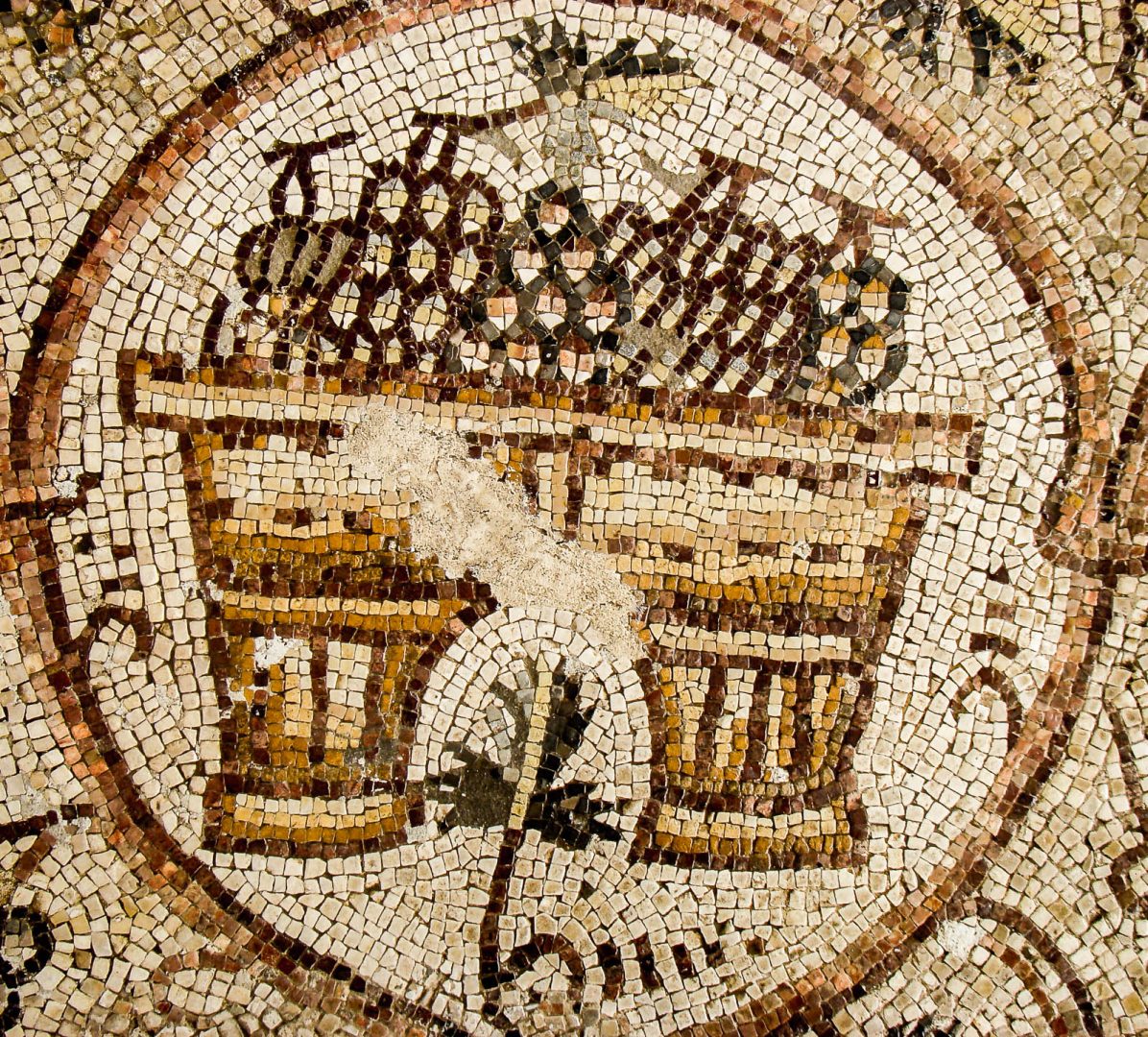
In this research, 134 mosaics were isolated from the hundreds of mosaics of the Late Roman and Byzantine periods uncovered in Israel up to the end of 2013, mosaics that present representations related to agriculture. These mosaics reveal 30 types of crops, eight tools, various kinds of agricultural labour, and a number of containers for the agricultural produce and for its transport by man and beast. This range of illustrations tells us a great deal about the rich local agriculture, particularly in relation to the small size of the country, and about local culinary preferences in relation to this broad agricultural output.
Method
The study is based on an interdisciplinary examination that combines archaeology, botany, horticulture, history, art and ancient literary sources. Plants, tools and agricultural labour were identified by cross-checking the visual features of each mosaic against agricultural knowledge, the archaeological finds, and the evidence of the Bible, rabbinic literature and Greek and Latin literature.
The two volumes
The Research Volume contains chapters on the domestication of plants and the history of agriculture; on mosaic as painting with tesserae; on each crop – pear, stone pine, asparagus, peach, citron, grapevine, cereals, cherry, cucurbits, olive, apricot, hawthorn, opium poppy, flowers, garlands and wreaths, artichoke, pomegranate, plum, jujube, almond, sycamore fig, fig, date palm and apple; on agro-technology – pruning and grafting; on tools – billhook, scythe, two-pronged drag hoe, forked tool, kitchen knife and hatchet; on baskets; and a statistical analysis with the conclusions.
The Corpus Volume gathers the mosaics examined, with their technical data, dating, location, quality of execution, and the agricultural depictions documented in each of them.
Main findings
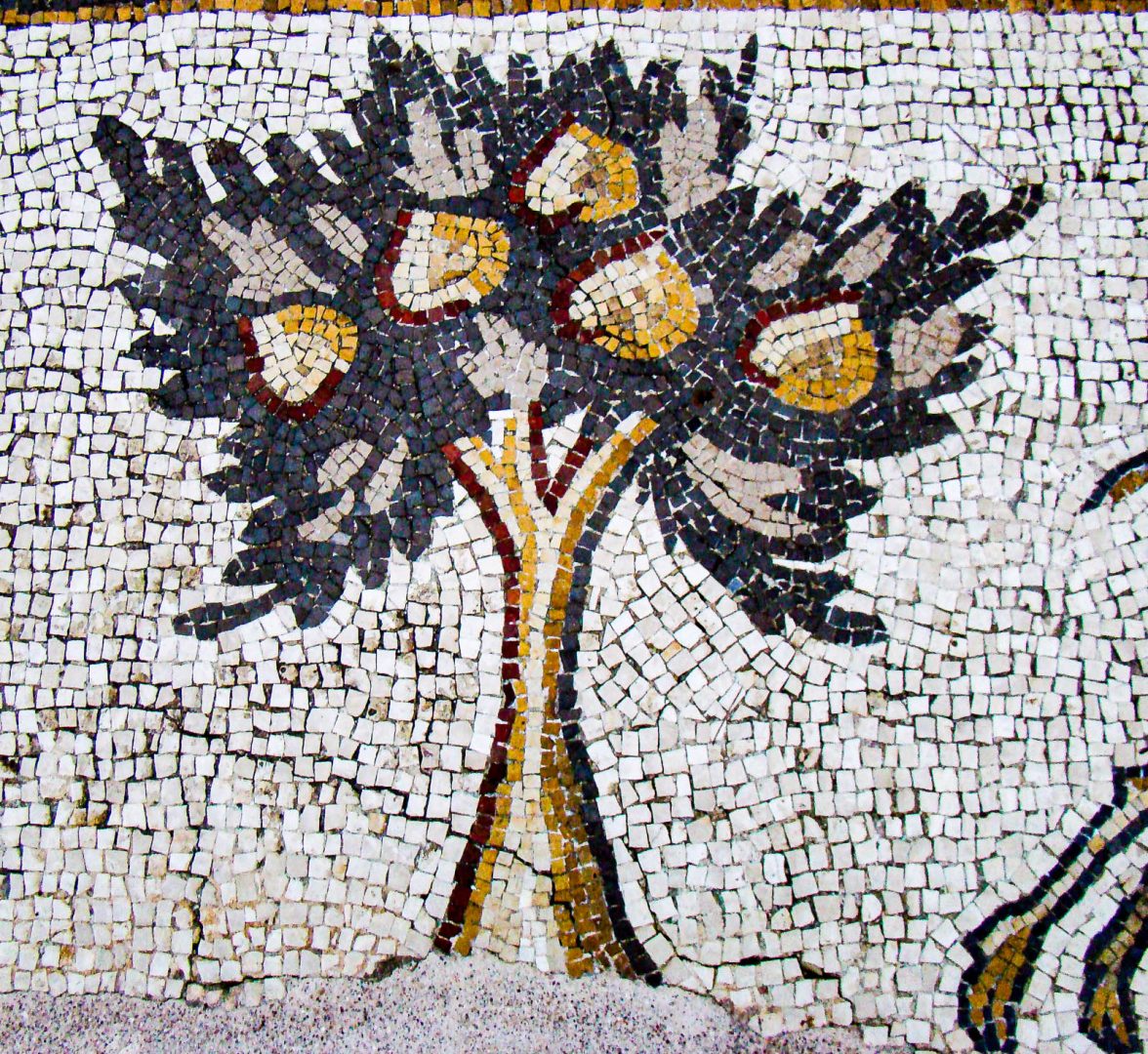
The grapevine appears in about 80% of the mosaics. The higher the quality of a mosaic, measured by the density of its tesserae, the more agricultural details it shows. Over 75% of the agricultural mosaics were made in Christian buildings.
The mosaics of the Land of Israel are an important documentary source for daily life, agriculture, the economy and material culture in antiquity. The depictions attest to close observation of nature and of agricultural activity, and to practical familiarity with crops, tools and processes of production.
No two mosaics in the Land of Israel are identical in all their details. Geometric frames and basic patterns passed between workshops and regions, but the depictions created within the medallions and scenes are not identical copies: each work was adapted anew to its place, its patron, its building and the local reality. This shows the artistic independence of the local artisans and their strong tendency toward realistic depiction.
From the dissertation to The Mosaic Book
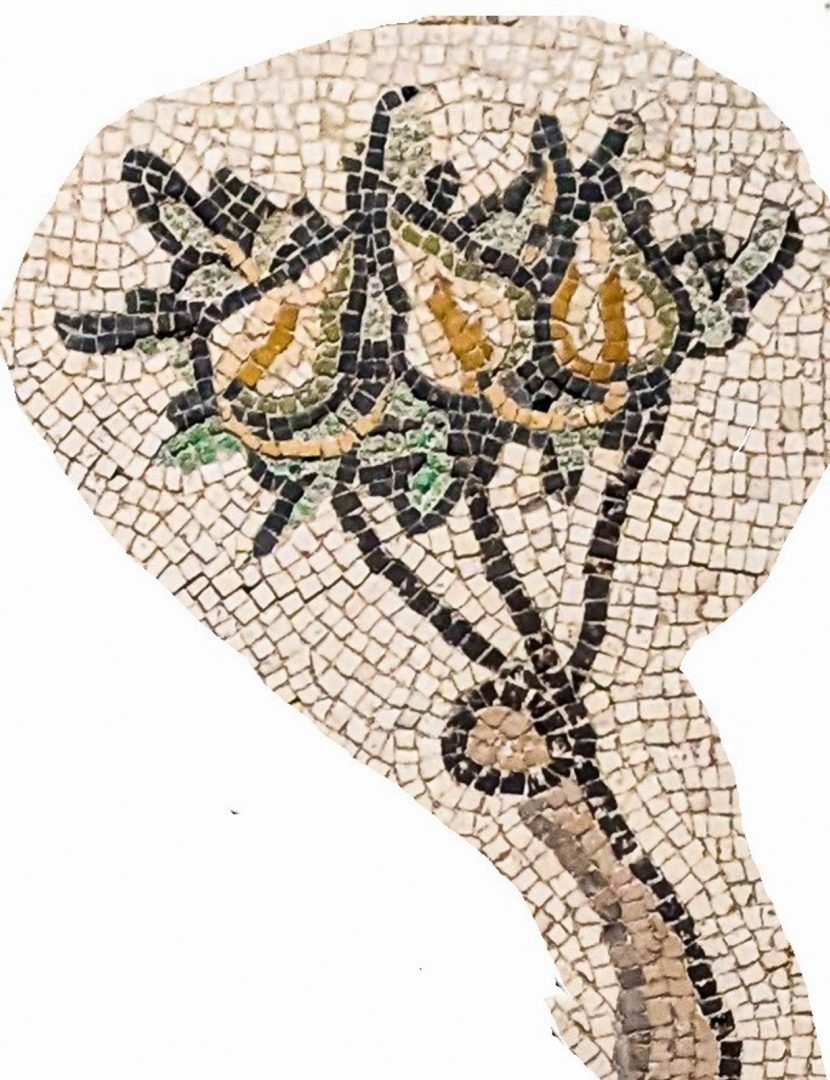
The dissertation reflects the state of research and the finds known up to the end of 2013, and it is presented here in full as a research document of 2014. The research has continued since then and has expanded to further fields – plants, birds, mammals, tools, crafts and daily life in the mosaics of the Land of Israel and in parallel mosaics throughout the Roman and Byzantine world. New identifications, mosaics discovered after the completion of the dissertation, and the continuously updated research appear in The Mosaic Book, for example in its chapters on birds in the mosaics and on mosaic sites.
Related English articles: The Originality of the Unique Agricultural Depictions in the Samaritan Synagogue Mosaic at Samara · Illustrations of Birds in Byzantine Mosaics from Judea, Samaria and the Sharon · Exceptional Mammals and Birds from the Roman Mansion Mosaic in Lod.
How to cite
Avital, A. 2014. Representation of Crops and Agricultural Tools in Late Roman and Byzantine Mosaics of the Land of Israel, Research Volume and Corpus Volume. PhD dissertation, Bar-Ilan University, Ramat-Gan [Hebrew, with English abstract].


