
Twelve bird species and eighteen mammal species in the Roman mansion mosaic at Lod (Late Roman period) – among them the great tit, the house sparrow and the black-headed gull, the hartebeest, the oryx, the rhinoceros, and a hippopotamus with a mythological fish tail.
Dr. Anat Avital, Independent Researcher · Revised English edition, 17 November 2026
Originally published in Hebrew: Avital, A. 2024. “Exceptional Mammals and Birds from the Roman Mansion Mosaic in Lod.” Lod “Diospolis – City of God”: Journal of the History, Archaeology and Heritage of Lod 10 (ed. A. Shavit): 99–122 [Hebrew, with English and Arabic abstracts].
This is an updated English edition, revised in light of the progress of research. Figure numbers in the text refer to the printed Hebrew article; the Hebrew text, with the author’s photographs and a recorded lecture, appears on the Hebrew page of the article. The English text is also available as a PDF on Academia.edu. The birds of the Lod mosaic are treated species by species in The Mosaic Book, Dr. Avital’s online encyclopedia of flora and fauna in the mosaics of the Land of Israel: Resident Birds, Domestication of Birds for Human Use and Waterbirds and Migratory Birds. A related English article: Illustrations of Birds in Byzantine Mosaics from Judea, Samaria and the Sharon. All of the author’s publications: Publications.
Abstract
The Roman mansion mosaic in Lod presents precise depictions that have won much praise for the high quality of the mosaic and the vitality of its figures. This article deals with the study of the Lod mosaic and is part of a large and comprehensive study of the flora and fauna in Roman and Byzantine mosaics in the Land of Israel and their comparison with mosaics of these periods in the surrounding region, Transjordan and the Mediterranean basin. The mosaic is distinguished by a wealth of images, mainly from the animal world. Twelve species of birds and eighteen species of mammals are depicted in it, among them several birds and mammals not identified until now in other mosaics of the Roman and Byzantine periods in the Land of Israel. The article focuses on the species unique to the mosaic of the triclinium of the Lod mansion: among the birds, the black-headed gull, the great tit and the house sparrow; and among the mammals, the hartebeest (bubal), the oryx, the rhinoceros and the hippopotamus. The identification of these animals contributes to our knowledge of the birds that have accompanied man from antiquity to the present, among them seabirds that followed the fishing boats. Some of the depictions of mammals reconstruct a local landscape in which large mammals that became extinct during recent centuries also lived. The African savanna scene, in which large mammals are shown, perhaps documents a daring journey of the owners of the building in Lod to Africa, and their connection with the cult of Neptune, god of the sea, and with the sources of fresh water.
Keywords: Lod mosaic, birds in mosaics, mammals in mosaics, Roman mosaics, Roman art
Introduction
The Roman mansion mosaic in Lod is a large and splendid floor mosaic that was uncovered in excavations of the Israel Antiquities Authority in 1996 (Gorzalczany 2016 and further references there; Gorzalczany and Shoeff 2022: 148–151). The mosaic is decorated with a variety of depictions of plants, molluscs, fish, a marine mammal, seabirds, mammals and land birds. It is one of the most impressive, largest and highest-quality mosaics of the Roman period found in the Land of Israel (Avital 2014, corpus volume: 212–214).

The mosaic floor of the triclinium in the luxurious Roman mansion was discovered in a salvage excavation conducted by Miriam Avissar on behalf of the Israel Antiquities Authority on HeHalutz Street in Lod (map ref. 19100/65147). The excavation exposed parts of the building and the magnificent mosaic set into its floors (Avissar 1996), which is dated to the Late Roman period, the end of the third to the beginning of the fourth century CE; it is about 17 m long and about 9 m wide (Avissar 1996: 157; Zilberstein 2009).
In preparation for the construction of the Shelby White and Leon Levy Museum as the permanent home of the mosaic, it was lifted for treatment and conservation and was sent for display in museums around the world (Abu Diab 2015). During this time, from 2009 onwards, further excavations were carried out at the site by Miriam Avissar and Amir Gorzalczany, with the aim of preparing the site to receive the mosaic in its original location and of understanding the architectural complex within which the mosaic had been installed.

The excavation exposed another mosaic south of the triclinium, and it was found to decorate the centre of a peristyle courtyard (a courtyard surrounded by columns or arcades) 13 m long and 11 m wide. To expose this mosaic completely, the course of the modern HeHalutz Street, which had been paved over it, had to be changed, so that only in 2014 was it possible to continue the excavation and expose the southern mosaic in its entirety. The date assigned to it is later than that of the triclinium floor, although both were in use together in a single building for part of its existence. In this article the two mosaics are discussed together in the study of the identification of the birds and mammals and in their count.
Together the mosaics complete the picture of a luxurious Roman mansion, with a splendid triclinium adjoining a peristyle courtyard, both with mosaics richly decorated (Gorzalczany 2015; Gorzalczany 2016; Gorzalczany et al. 2016). The size and quality of the mosaics reflect the high standard of living of the owners of the house, people of great wealth, who chose to settle in the quarter in which the cultural, social and economic elite of the city of Lod lived in the Late Roman period (Gorzalczany 2018).
Research method
This research began with photographing the Lod mosaic.1 Subsequently, all the birds and mammals depicted in the mosaic were defined and taxonomically identified, in comparison with depictions in mosaics of the Roman and Byzantine periods in Israel and throughout the Roman and Byzantine empires. The identification of the animals was based on earlier studies (Avissar 1996; Talgam 2015), observations, personal knowledge and experience, field guides, lexicons, professional literature and scientific websites. Help was received from fellow researchers who gladly contributed from their knowledge, and I thank them for it.
The quality of the mosaic
The main measurable component used to test the quality of mosaics is the size of the mosaic stones (tesserae), and of course the range of colours. Each tessera is a pixel in the large picture, and their size defines the resolution. The smaller the stones and the greater the range of colours, the higher the quality of the mosaic and the more details it shows. The figurative depictions in the Lod mosaic are made of particularly small coloured stones, about a quarter of a square centimetre in size (about 400 tesserae per dm²),2 and they allow a very high resolution relative to a given area and in comparison with other contemporary mosaics throughout Israel (Avital 2022: 186). This high resolution allows a detailed expression of gradations of colour and of precise details in the mosaic illustrations, which were usually viewed while sitting or reclining on the couches or standing near them during a visit to the building; these place the Lod mosaic among the highest-quality mosaics in Israel from the Roman and Byzantine periods (Avital 2014, corpus volume: 212).
The Lod mosaic excels in precise, realistic and vivid depictions of a variety of plants, molluscs, fish, a marine mammal, birds and land mammals. A further advantage of the mosaic is its large area, whose excellent preservation is exceptional, and it is among the most impressive mosaics of the Roman period discovered in Israel up to the time of writing.
The range of birds in the Lod mosaic
Twelve different species of birds were identified in the mosaic (among them a duck identified only at the level of the genus; Table 1). The precise and realistic depictions allow identifications with a high degree of certainty for the large bird species, and with a good degree of certainty for the small species, the songbirds. The identification relies on the colours of the tesserae relative to the colours in reality, the bird’s stance, the body structure and the range of its parts, feeding habits, the habitat and surroundings of the bird, its size, and the general impression it conveys to the ornithologist and to anyone who knows birds well today.
Table 1: The range of bird species in the Lod mosaic
| # | Bird | Scientific name |
|---|---|---|
| 1 | Duck (genus) | Anas |
| 2 | House sparrow | Passer domesticus |
| 3 | Alexandrine parakeet | Psittacula eupatria |
| 4 | Chukar partridge | Alectoris chukar |
| 5 | Indian peafowl | Pavo cristatus |
| 6 | Egyptian goose | Alopochen aegyptiaca |
| 7 | Rock dove | Columba livia |
| 8 | Great tit | Parus major |
| 9 | Grey-headed swamphen | Porphyrio poliocephalus |
| 10 | Black-headed gull | Chroicocephalus ridibundus |
| 11 | Eurasian collared dove | Streptopelia decaocto |
| 12 | Domestic chicken | Gallus gallus domesticus |

Compared with all the mosaics of the Roman and Byzantine periods discovered in Israel, the Lod mosaic shows only two species fewer than the mosaic richest in bird species in Israel – the mosaic of the Armenian burial chapel in Jerusalem – which is decorated with fourteen species and genera of birds. Compared with other mosaics with a large range of bird species, the Lod mosaic was decorated with only one species fewer than the mosaic of the church at ‘Ein Sheva (Tabgha), and with the same number of species as the mosaic of the synagogue of Ma‘on-Nirim.
Birds depicted uniquely in Israel
Of the twelve bird species shown in the Lod mosaic, an identification can be proposed for three birds whose depiction is unique among all the mosaics of Israel from the Roman and Byzantine periods surveyed so far: the great tit, the house sparrow and the black-headed gull. All three are depicted in the triclinium mosaic.
Great tit
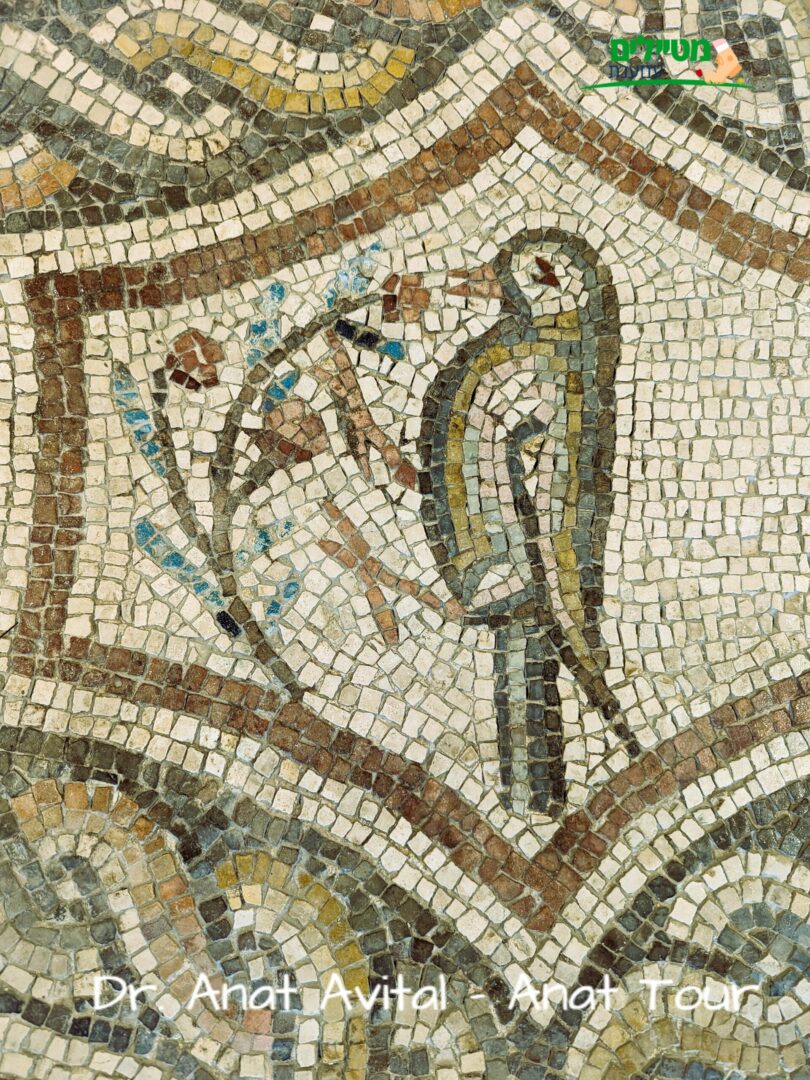
The great tit appears in a unique depiction in the Lod mosaic. The tit is depicted within a geometric frame in the southern carpet of the triclinium mosaic, among further frames containing designs of plants, fish, birds and mammals (Fig. 1). The bird stands on the branches of a rose bush and picks insects to eat. The great tit is one of the common resident songbirds in Israel in areas of human habitation and woodland (Fig. 2). The yellow parts of the breast and belly and the dark back are clearly illustrated in the mosaic. The white patch below the eye is depicted as a round white patch around the eye. The bill is thin and sharp. The habits of standing on branches and of eating insects from rose bushes are clearly visible in the mosaic (Heinzel, Fitter and Parslow 1975: 266–267; Oren Hasson, oral communication). It seems that the bird in the mosaic is a male, according to the familiar identification mark of the elongated black stripe on the breast and belly (Israeli birding website: great tit).
House sparrow
The house sparrow, also depicted uniquely in the Lod mosaic, is illustrated within a geometric frame in the southern carpet of the triclinium mosaic, among further frames containing designs of plants, fish, birds and mammals (Fig. 3). The sparrow stands on a rose branch and pecks insects from the flower. Unlike the depiction of the tit, in which the roses are shown from the side and from a greater distance and were therefore made smaller, in the sparrow decoration the rose is seen from above as an open flower. The sparrow illustrated is a male with a black bib on its breast; the belly is light-white, the eyebrow white, the cheek light grey, the back dark in grey and brown, the legs brown, and the bill black, thick, strong and pointed at the tip (Fig. 4). These features are well depicted in detail in the mosaic. The sparrow is a resident songbird that was very common in areas of human habitation in Israel until recent decades and until the influence of the arrival of invasive birds, the common myna and the parakeet, which take over the nests of sparrows and cause their displacement and the reduction of their population (Colléony and Shwartz 2020).
Black-headed gull
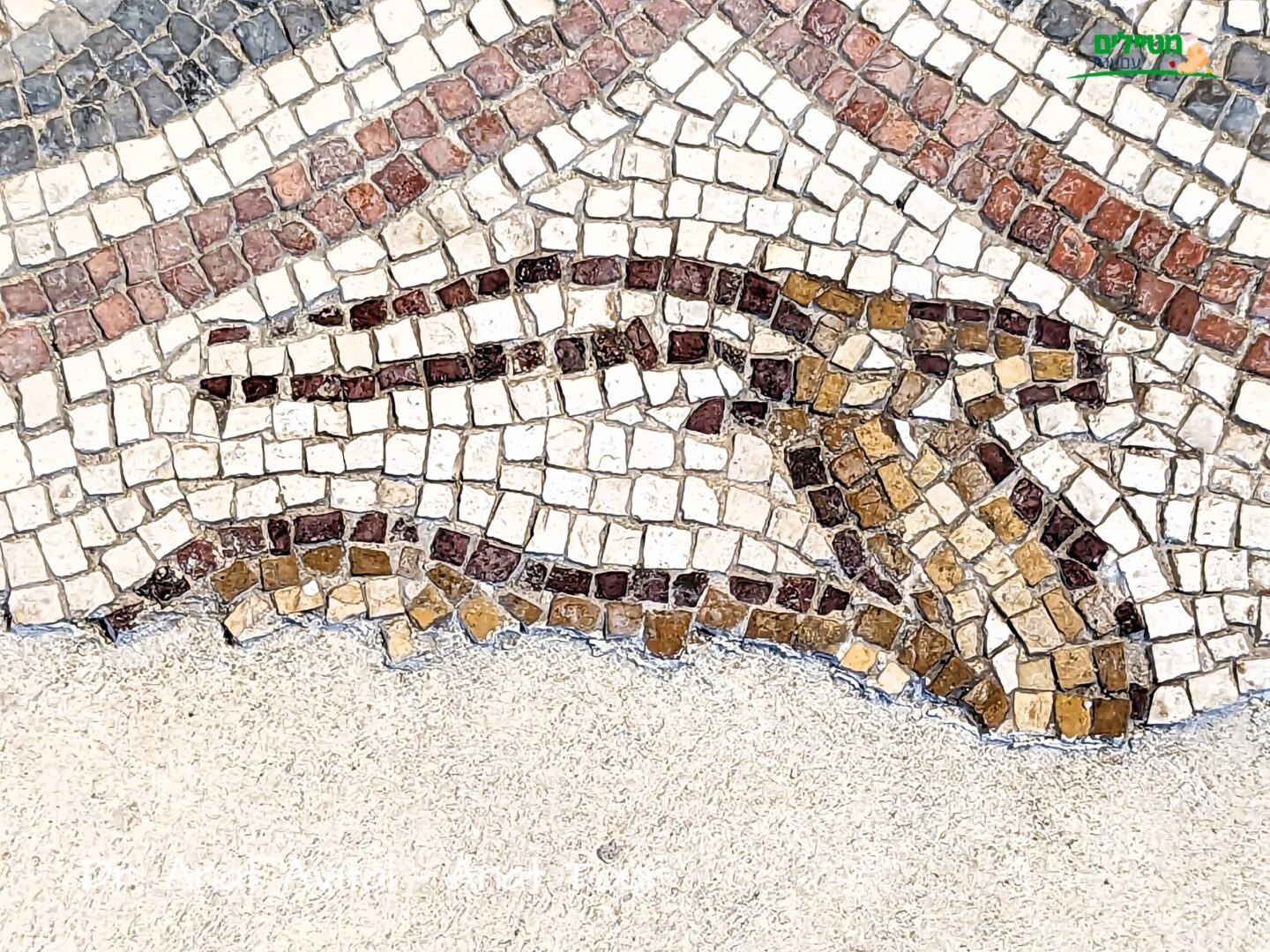
In the large and detailed mosaic of Lod, in the marine scene at the centre of the triclinium carpet, a unique and very charming illustration is tucked away: a gull inside a fishing net on the stern of a large fishing ship. The artisan conveyed a message touching on the everyday life that accompanies seafarers – for example the gulls, which tend to follow fishing boats and wait for easy prey of fish brought up in the fishing nets. The illustration apparently succeeds in conveying to the viewer the image of a bird that looks content and sated amid the catch of fish that has fallen to its lot, and now it rests and is not busy eating. The creator of the mosaic may even have personified the bird with a satisfied face (Figs. 5, 6).

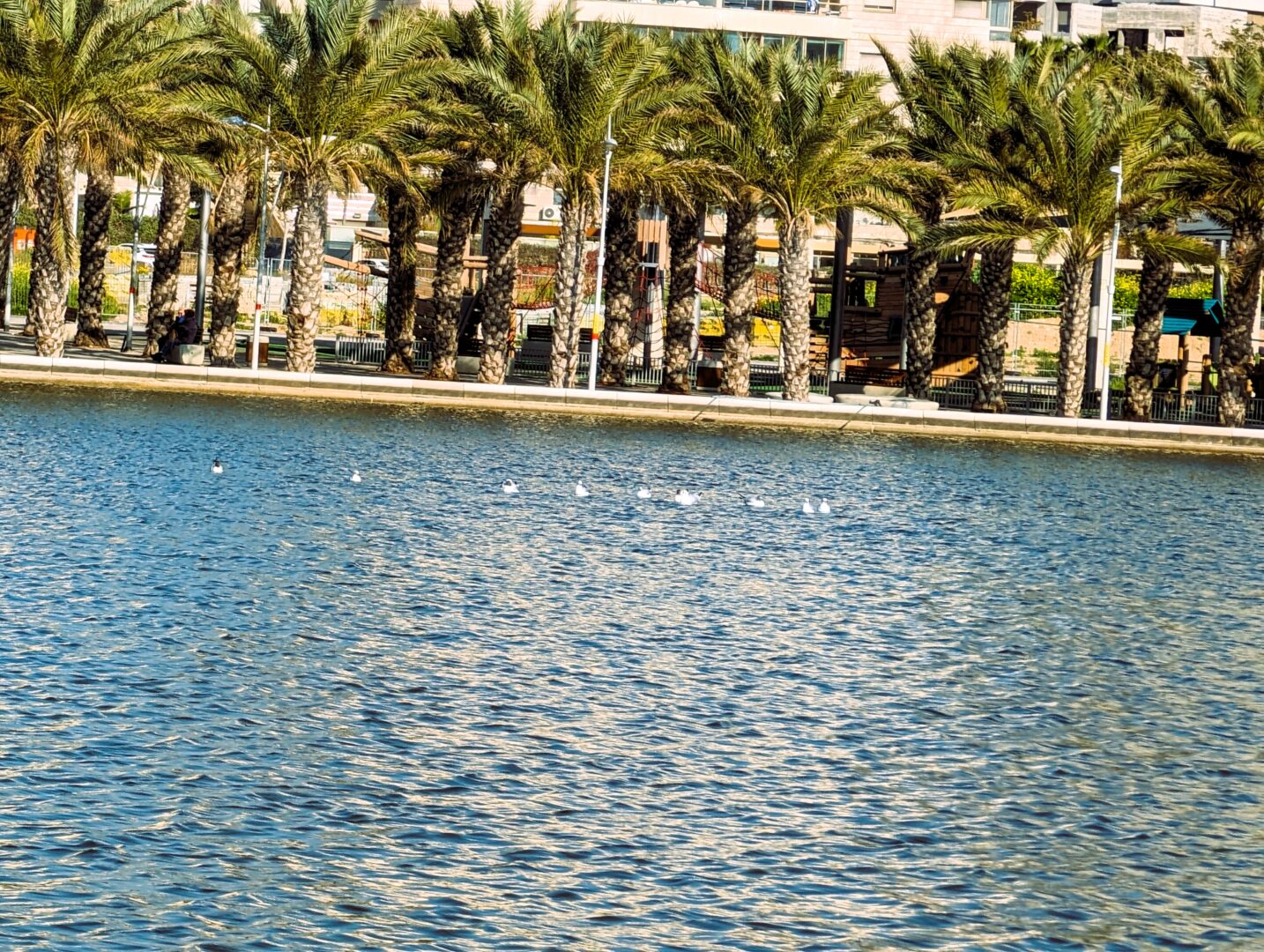
It is difficult to determine with certainty the species of the gull in the illustration, because all the appropriate colours are absent, because of the small size of the illustration, and because only part of the bird is shown. Nevertheless, an identification can be proposed on the basis of its features – the black-headed gull – the commonest and best known of the gulls nesting in our region, which lives in very large flocks in the coastal plain (Fig. 7). The head colour of the black-headed gull changes between summer and winter plumage. In the mosaic the gull is seen in winter “dress”: its head is light, with only remnants of the dark colour of the summer “dress” on the crown. The black-headed gull has a white ring around its black eye, usually visible to the viewer only in its rear part. In the mosaic the ring is imitated by a single white stone at the rear of the black eye. The gull in the mosaic has a bill with a black spot at its tip, characteristic of young black-headed gulls up to a year old (Paz 1993: 239–240).

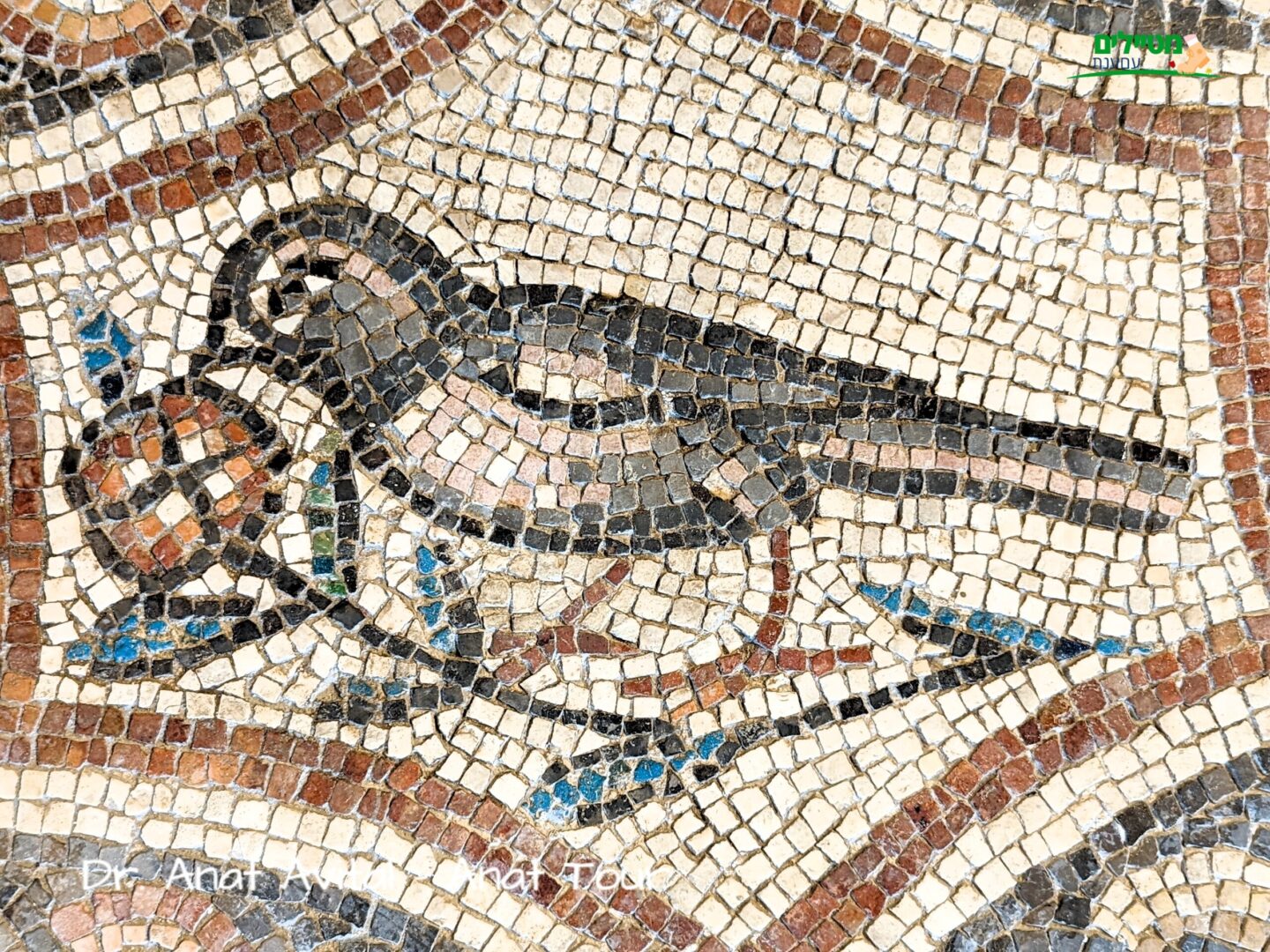
In the illustration of the second ship in the marine scene another bird is depicted: a duck lying at ease in the tangle of the fishing net (Fig. 8). This ship was apparently damaged and had reached the shore for repair (Haddad 2019: 32–35), and the duck may have arrived on it at this stage, to rest after migrating over the Mediterranean or during its winter stay on the shores of Israel. The species of the duck cannot be identified. Both depictions are realistic and touch on the everyday life of seafarers and fishermen, conveying to the viewer a picture from among their many experiences at sea.
Birds depicted uniquely in mosaics of the Roman and Byzantine periods in Israel
The birds presented above are not the only ones identified in a unique depiction in mosaics of Israel from the Roman and Byzantine periods; eleven further birds have been identified in a unique depiction in other mosaics (Table 2):
Table 2: Birds illustrated uniquely in mosaics of the Roman and Byzantine periods in Israel
| # | Bird | Scientific name | Site |
|---|---|---|---|
| 1 | Purple heron | Ardea purpurea | Kafr Kama, chapel |
| 2 | Bearded vulture | Gypaetus barbatus | Jerusalem, Orpheus burial chapel |
| 3 | Glossy ibis | Plegadis falcinellus | Beit Loya, church |
| 4 | Black francolin | Francolinus francolinus | Caesarea, Bird Mosaic |
| 5 | Great white pelican | Pelecanus onocrotalus | Caesarea, Bird Mosaic |
| 6 | Grey crowned crane | Balearica regulorum | ‘Ein Sheva (Tabgha), church |
| 7 | Red-breasted goose | Branta ruficollis | ‘Ein Sheva (Tabgha), church |
| 8 | Great cormorant | Phalacrocorax carbo | ‘Ein Sheva (Tabgha), church |
| 9 | Sandpiper (genus) | Tringa | Emmaus, villa |
| 10 | Common wood pigeon | Columba palumbus | Ma‘on-Nirim, synagogue |
| 11 | Sand partridge | Ammoperdix heyi | Ma‘on-Nirim, synagogue |
The range of mammals in the Lod mosaic
Eighteen species of mammals are shown in the Lod mosaic (among them a giraffe identified at the level of the genus and a dolphin identified at the level of the family; Table 3). The Lod mosaic shows the largest range of mammal species of all the mosaics of the Roman period discovered in Israel. Among the mosaics of the Byzantine period discovered in Israel, the Lod mosaic shows only one species fewer than the mosaic richest in species in Israel – the mosaic of the church at Be’er Shema – which is decorated with nineteen species and genera of mammals (Varga et al., forthcoming).
Table 3: The eighteen mammal species depicted in the Lod mosaic
| # | Mammal | Scientific name |
|---|---|---|
| 1 | Roe deer | Capreolus capreolus |
| 2 | Lion | Panthera leo |
| 3 | Cape hare | Lepus capensis |
| 4 | Domestic cattle | Bos taurus |
| 5 | Giraffe (genus) | Giraffa |
| 6 | Syrian brown bear | Ursus arctos syriacus |
| 7 | Dolphin (family) | Delphinidae |
| 8 | Common hippopotamus | Hippopotamus amphibius |
| 9 | Tiger | Panthera tigris |
| 10 | Nubian ibex | Capra nubiana |
| 11 | Domestic dog (subspecies) | Canis lupus familiaris |
| 12 | Leopard | Panthera pardus |
| 13 | Domestic horse | Equus ferus caballus |
| 14 | African elephant | Loxodonta |
| 15 | Mountain gazelle | Gazella gazella |
| 16 | White rhinoceros | Ceratotherium simum |
| 17 | Arabian oryx | Oryx leucoryx |
| 18 | Hartebeest (bubal; “ox-antelope”) | Alcelaphus buselaphus |
Mammals depicted uniquely in Israel
Of the eighteen mammal species represented in the Lod mosaic, an identification can be proposed for three mammals whose depiction is unique among all the mosaics of Israel surveyed so far from the Roman period: the hartebeest (bubal), the oryx and the rhinoceros; and also the hippopotamus with a cultic connection, uniquely depicted among the mosaics of the period. All four are depicted in the triclinium mosaic.
Hartebeest (bubal)
Hexagonal frames are designed in the northern carpet of the mosaic; in one of them a lioness hunting a hartebeest is depicted, one of the many realistic nature depictions in the mosaic (Fig. 9). The hartebeest is an antelope that lives in herds, inhabits grasslands, and is today especially common on the savanna plains of southern Africa. The pattern of the large curved horns, thick at their base and thin and sharp at their tips, is well illustrated in the mosaic (Fig. 10).

The hartebeest lived in the past in the Land of Israel and its surroundings. Aharoni heard from the Bedouin about hartebeest hunted in the area east of the Dead Sea at the beginning of the twentieth century (Aharoni 2000: 21–22), and it is therefore reasonable that the hartebeest was seen by the owners of the house in Lod or by the artisans who made the mosaic on their journeys in the Land of Israel or its surroundings, and that it was known to them. Dor held that the hartebeest had become extinct in the Land of Israel already in prehistoric times (Dor 1975: 36), and elsewhere identified the hartebeest with the biblical zemer, “the deer, the gazelle, the roebuck, the wild goat, the ibex, the antelope and the zemer” (Deuteronomy 14:5; Dor 1997: 40). Amar, Bouchnick and Bar-Oz identified the hartebeest with the biblical yaḥmur and noted archaeozoological finds of hartebeest remains from the Middle and Late Bronze Ages and from the Iron Age from the south of the country and from the coastal plain (Amar 2011; Amar, Bouchnick and Bar-Oz 2009).
Oryx
In the northern part of the mosaic, around the octagon containing the depictions of the African savanna (Fig. 11), polygonal frames are designed. In one of them a leopard is depicted in a fierce predatory grip, hanging on the belly of an oryx with its jaws closing on its neck. Blood flows from the oryx’s body at the wounds – from the claws of the leopard’s hind and fore limbs and from the injury to the artery of the neck (Fig. 12).
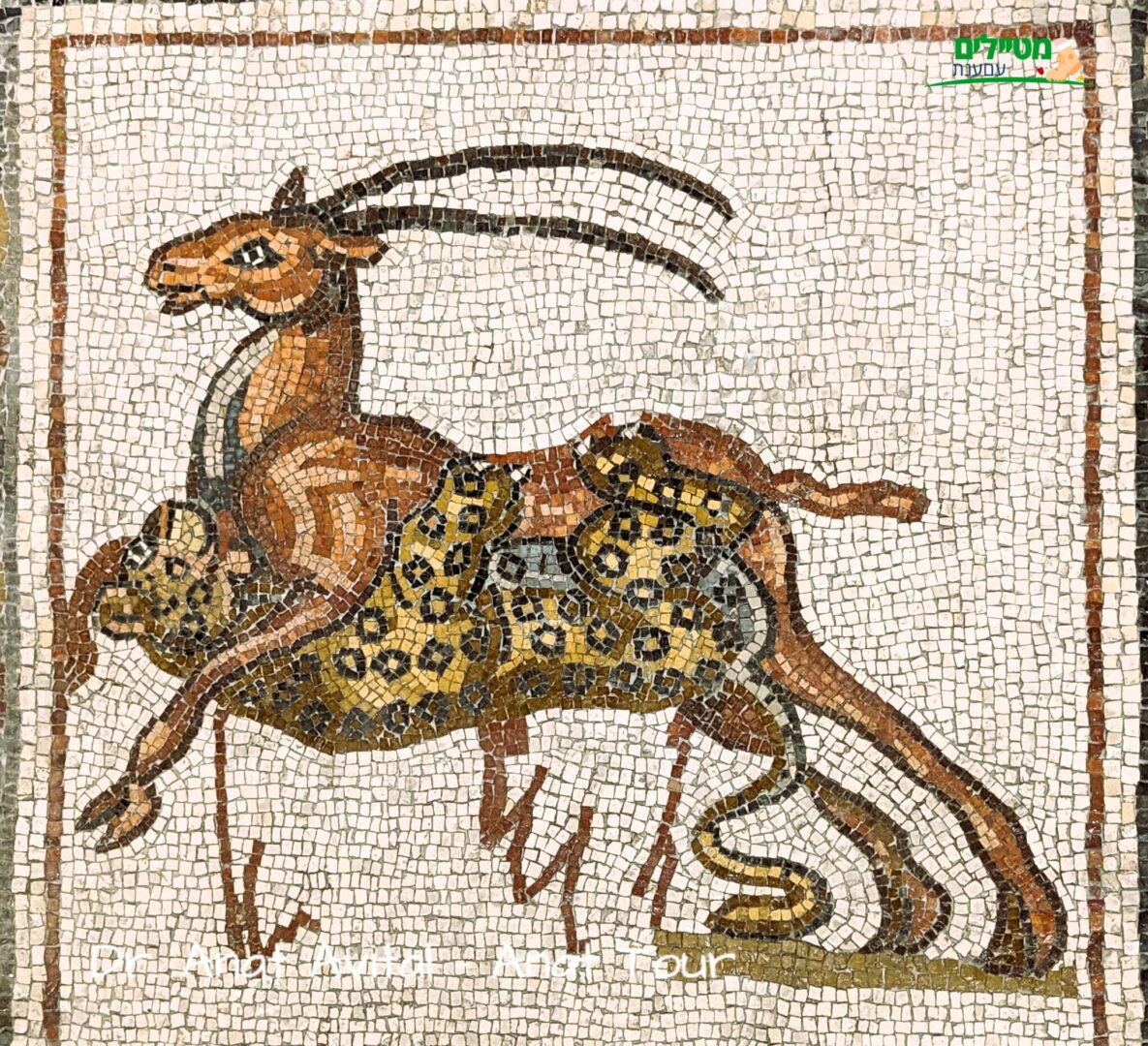
This is an amazing illustration and a realistic depiction of the hunting method of leopards, which tend to attack their prey from ambush, leaping on it from below, gripping it with their limbs, closing their jaws so as to ensure that the prey cannot escape, and using their canines to injure its neck artery. The injury to the neck artery causes heavy bleeding and suffocation and brings about the death of the prey within a short time. Strangulation is one of the most common ways in which large predators kill their prey, and it is an efficient way to kill large prey, since it causes a quick and painless death and helps reduce the prey’s resistance.3
In another frame, in the northern carpet of the mosaic, a lioness is depicted hunting a male oryx; she leaps on its back to bring it down and devour it (Fig. 13). In both illustrations the two long, curved horns characteristic of the oryx are well illustrated. From the depictions it is difficult to determine the species of the oryx, because the coat of the oryxes in the mosaic is designed in shades of brown and not in white, although it is reasonable that this is the Arabian (white) oryx (Fig. 14), which was common in the Negev until the beginning of the twentieth century and in Transjordan until the middle of the twentieth century (Dor 1975: 321–322; Mendelssohn and Yom-Tov 1988: 277–279). It seems that the creators of the mosaic chose to design the coat of the oryxes in shades of brown, and not in white or light colours, because of the need to create colour contrast with the white background of the tesserae. Nevertheless, it should be noted that the creator emphasized the dark patches on the cheeks and the dark patch on the nose, and even took care to design the forelegs in dark shades of brown and black (Fig. 13).

African savanna and a body of water
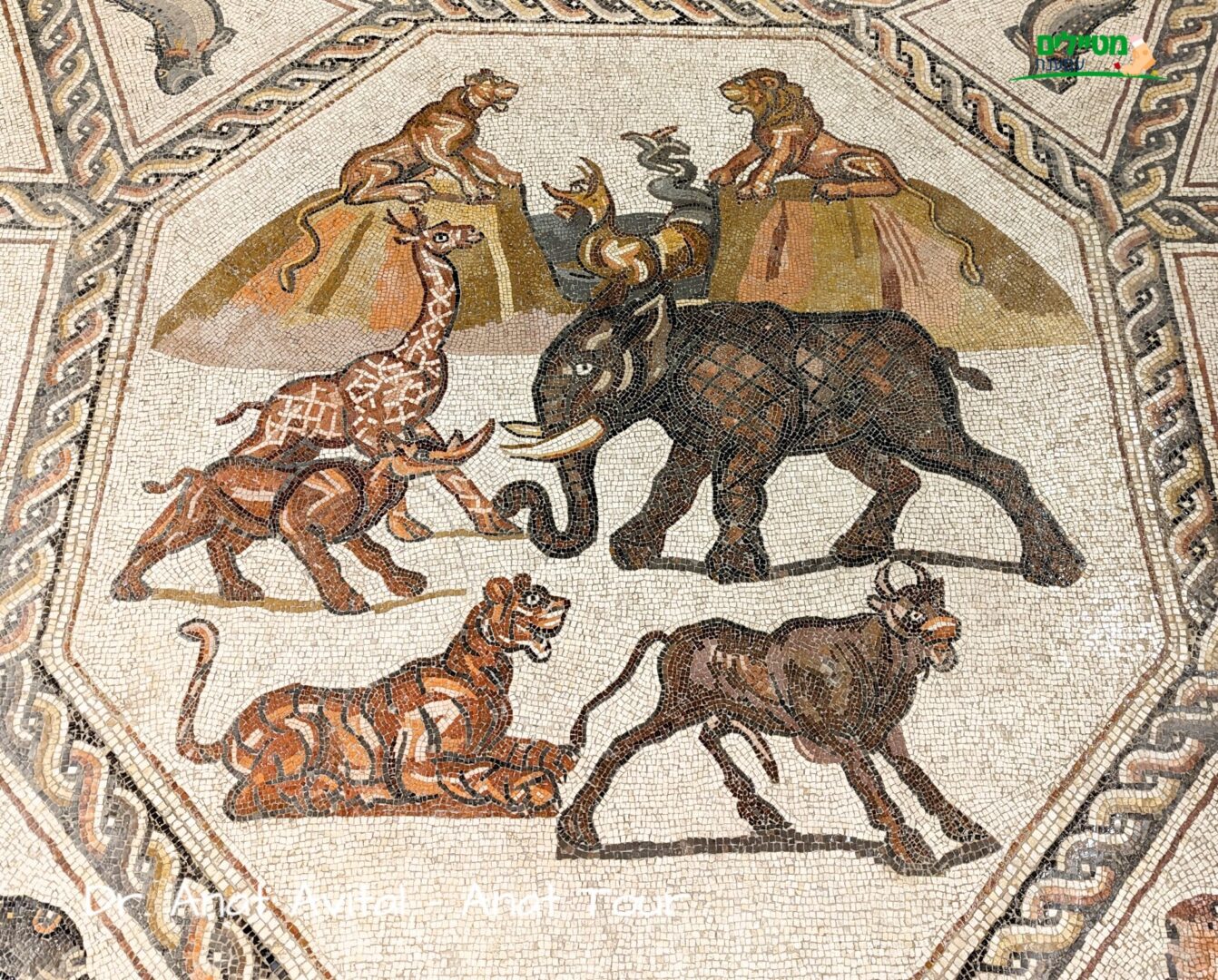
In the central carpet of the triclinium a large octagon is decorated with a scene of large mammals from the savannas of Africa (Fig. 11). A lion and a lioness guard hills on either side of a body of fresh water, representing the Nile, its sources, or a water source in the savanna. In the water lies a hippopotamus in a mythological context, with a curled fish tail. In the foreground of the scene further large mammals are depicted: an elephant, a giraffe, a rhinoceros, a lioness and a bull.
Rhinoceros
Outside the water source a rhinoceros is designed in a realistic depiction (Fig. 15), in a scene of a frontal struggle between it and an elephant, which looks like a confrontation over territory and access to the water source. The two large mammals are shown in frontal position facing each other, their bodies leaning forward in an attacking movement. Confrontations between elephant and rhinoceros are not rare in struggles for control over territory, water sources and vegetation;4 usually the elephant wins these struggles because of its weight, height and strength. The other large mammals in the scene do not appear to belong to the struggle, but they represent the fauna of the savanna.
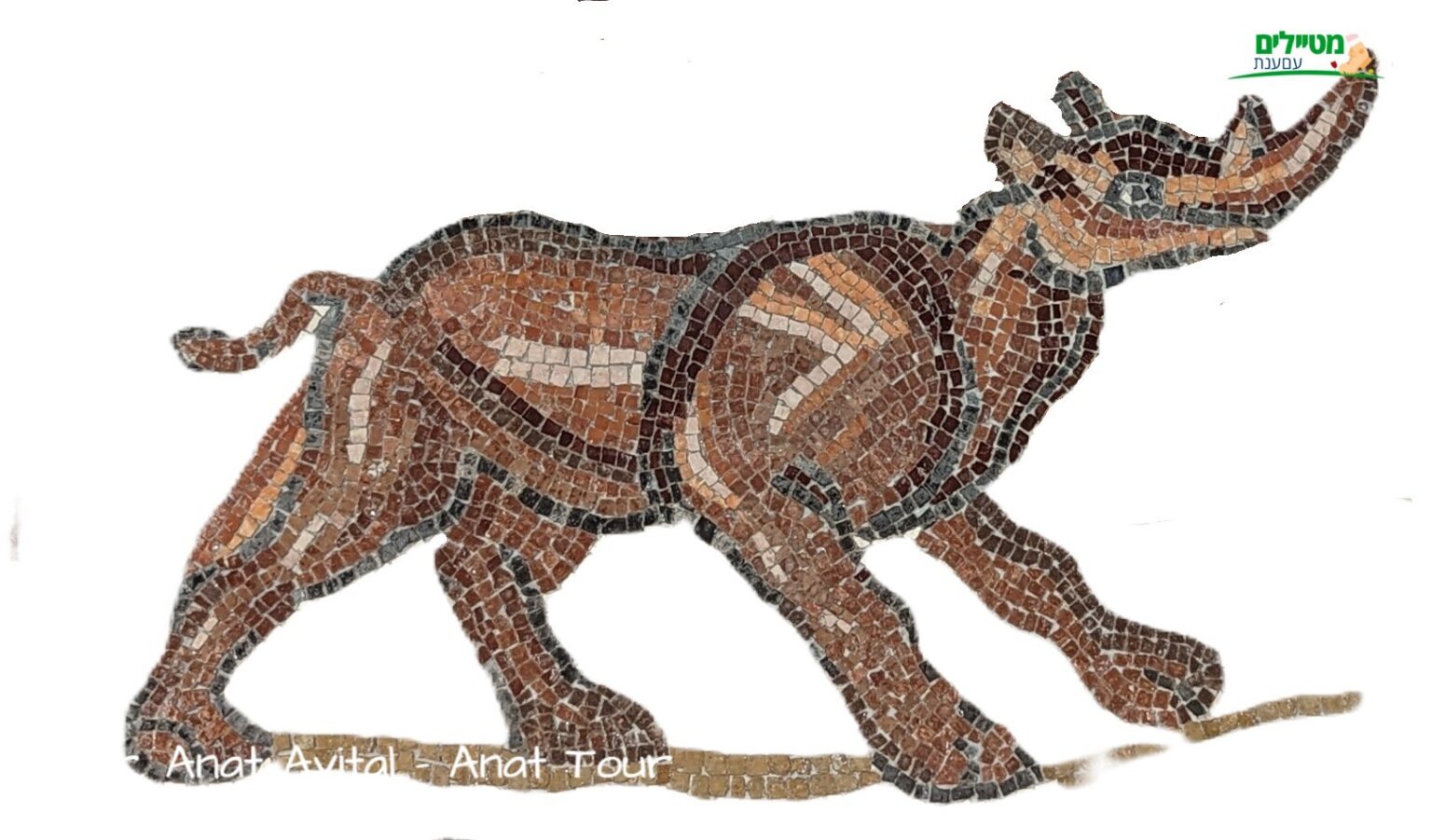
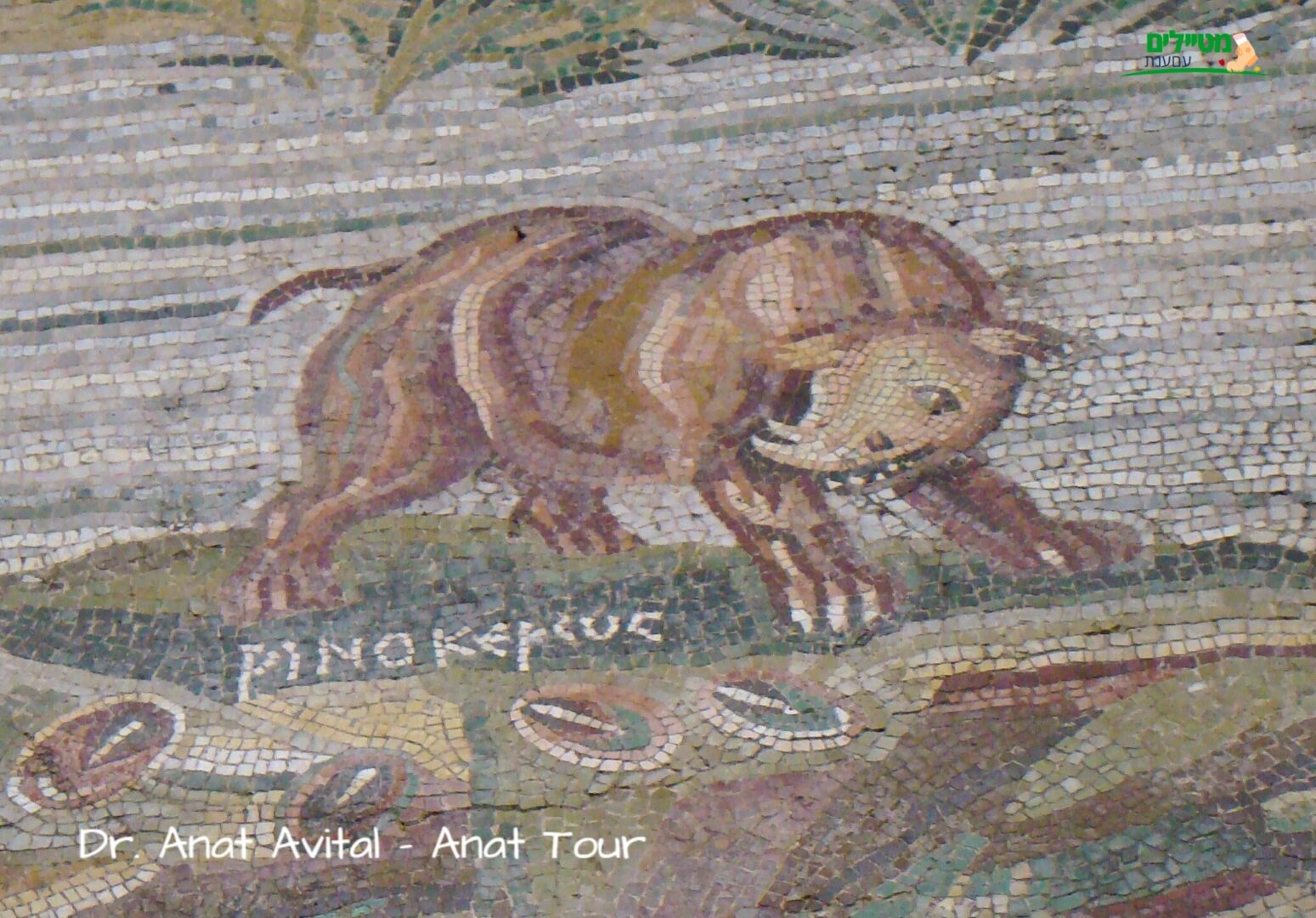
Rhinoceroses are not known in the depictions of the Roman and Byzantine mosaics in the Land of Israel, although depictions of other African animals do occur in them, for example the giraffe and zebra in the mosaic of the synagogue in Gaza (Ovadiah 1969), and the elephant and guineafowl in the church at Be’er Shema (Varga et al., forthcoming). In the wall paintings of the Sidonian burial cave at Marisa, dated to the second century BCE, African animals are designed in a row, among them a rhinoceros, next to the inscription of its name in Greek, rhinokeros, ῥινόκερως (Fig. 16), within a depiction of experiences of a hunting expedition, which was a favoured sport of the aristocratic classes (Peters and Thiersch 1905: 12; 90; Pl. VI).

In the sanctuary of Fortuna at Praeneste (Palestrina) in Italy, the famous Nile mosaic was installed in the first century BCE (Pliny XXXVI, 64), in which a rhinoceros is depicted, it too beside the inscription of its name in Greek (Fig. 17), one of the other African mammal species designed in the mosaic beside captions with their names in Greek, and placed in the landscape of their natural habitat.
Most of the exotic depictions of African Nile landscapes in mosaics of the Roman and Byzantine periods in Israel are accompanied by explanatory captions, for example the goddess “Egypt”, Aigyptos, ΑΙΓΥΠΤΟΣ, and the gates of Alexandria, ΑΛΕΣΑΝΔΡΕΙΑ, in the mosaic of the House of the Nile Festival at Sepphoris (Weiss and Talgam 2002: 62, Fig. 8; 65, Fig. 10). It seems that in cases where the depictions in the mosaic were not local and not familiar to the inhabitants of the site and to visitors to the building, there was a preference for adding captions and explanations to the exhibits, as in an encyclopedia or in a map of foreign lands, which most visitors to the mosaic site had not reached and would never reach in their lifetimes.
Hippopotamus with a mythological curled fish tail
In the body of water lies a hippopotamus with gaping mouth, the rear part of whose body is depicted as a curled fish tail like that of a mythological sea creature (Fig. 18). The hippopotamus is shown lying in the water, leaning only on its forelegs, with its curled tail raised up behind it. Its body is brown and realistic, apart from the grey curled fish tail attached to it imaginatively.

Hippopotamuses usually lie during the day in pools of water in the savannas of Africa and in the Nile to cool their large bodies; at night they come out to graze outside the water. When the hippopotamus lies at rest in the water only the upper part of its body protrudes – the back and the upper part of the head, from which the pointed ears facing forward, the protruding eyes and the nostrils, raised for breathing, can be seen (Fig. 19). In the illustration of the hippopotamus in the mosaic, pointed ears facing forward, large round protruding eyes, a wide-open mouth and two light-coloured tusks can be seen.

During conflicts among themselves hippopotamuses tend to open their mouths wide facing each other, exposing their large tusks and uttering warning sounds (Fig. 20). The scene in the mosaic imitates well the routine reality of the behaviour of herds of hippopotamuses in the rivers, lakes and seasonal water sources in which they abound.5
The hippopotamus, the large and dominant creature in the waters of Africa, is one of the symbols of the god Nilus. In Roman and Byzantine statues and mosaic pictures the god Nilus is shown borne on the back of a hippopotamus or leaning on it – for example in the house of Kyrios Leontis, the Jew, at Beth Shean, of the sixth century CE, in a mosaic carpet with Nilotic motifs, among them the caption Alexandria, ΑΛΕΣΑΝΔΡΕΙΑ, where the god Nilus is shown riding on the back of a hippopotamus (Guimier-Sorbets 2023: 240–245).
The curled fish tail of the hippopotamus in the Lod mosaic resembles marine or land creatures with a curled fish tail that accompanied the cult of the Roman gods Neptune and Oceanus, gods of the waters and currents, the sea and the tidal waves (Boßler 1864: 8–10; Bad Vilbel museum website; Servi 2012: 34–35).
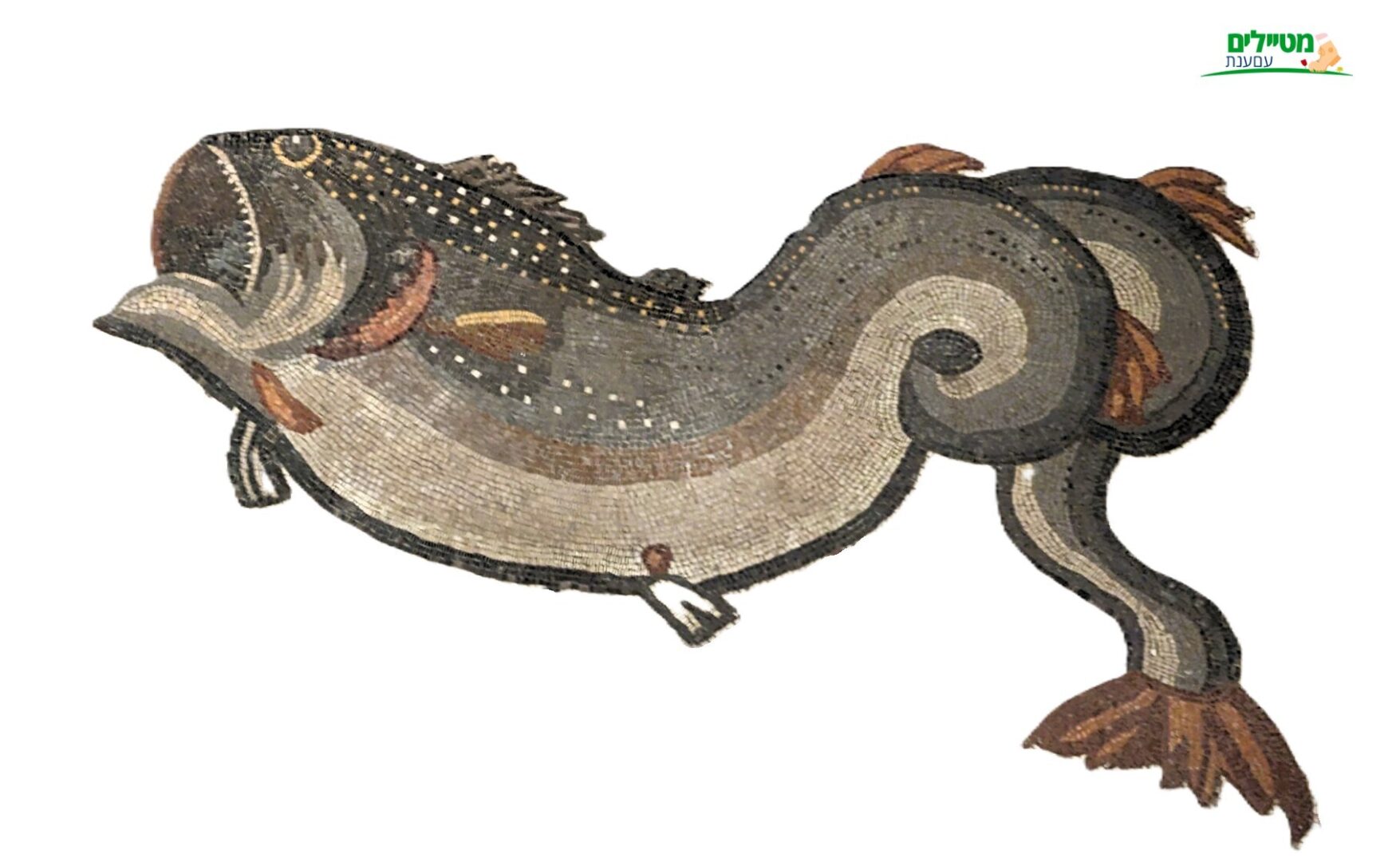
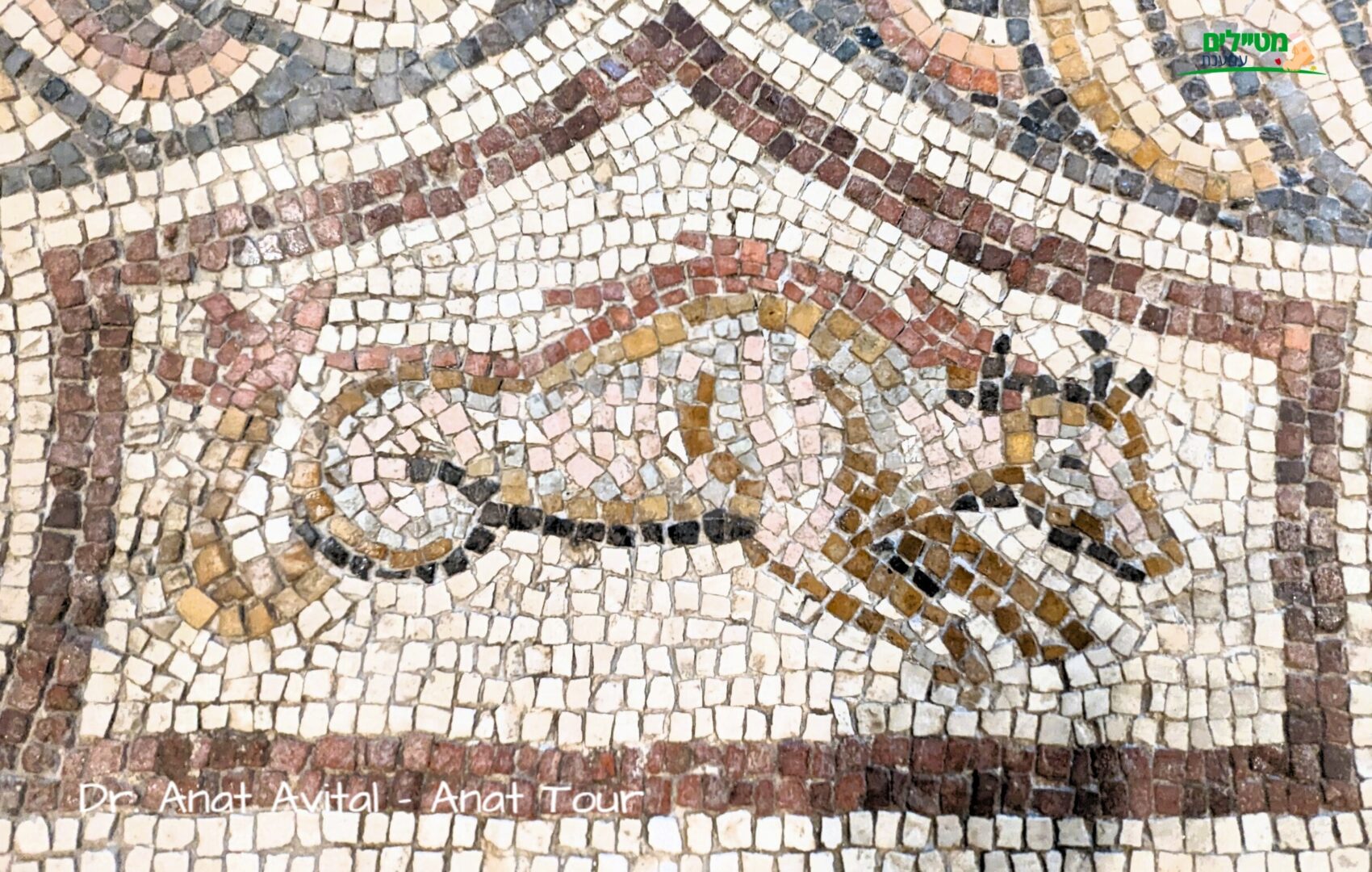
Like the illustration of the hippopotamus, other large animals in the Lod mosaic were designed as imaginary marine creatures with a mythological curled fish tail, for example a large fish in the upper right part of the marine scene (Fig. 21) and a hippocampus (sea-horse), a creature whose front part is a horse and whose rear is a curled fish tail, shown in a polygon in the carpet in the southern part of the triclinium (Fig. 22). The African scene apparently shows a fusion of the hippopotamus, one of the symbols of the god Nilus, with a curled fish tail, one of the symbols of Neptune.
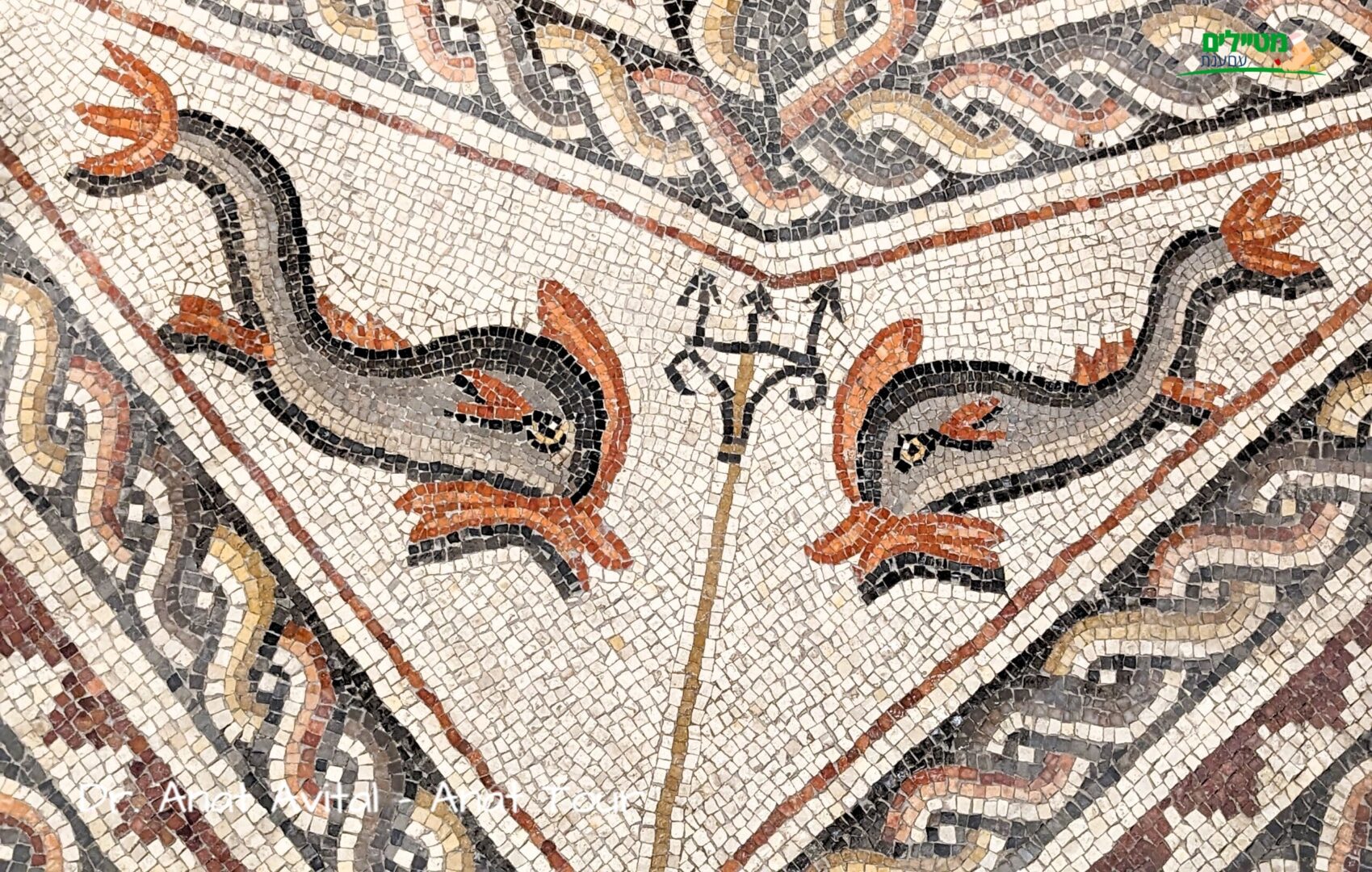
Further elements symbolizing the cult of Neptune were incorporated in the Lod mosaic: dolphins, a three-pronged fork (trident) and shells in the sea (Servi 2012: 34–35). The appearance of the symbols of the cult of Neptune contains a possible hint of a connection of the owners of the house in Lod with the god of the sea.
Discussion and summary
The Lod mosaic is distinguished by exceptional quality. Its area is large, it is well preserved, and it is among the most impressive mosaics of the Roman period discovered in Israel. It shows rich, precise, realistic and vivid images of a variety of plants. Most of the decorations are of creatures from the animal world: birds and land mammals, fish, a marine mammal and marine molluscs. The figurative depictions in the Lod mosaic were designed with particularly small coloured stones, which allow a very high resolution relative to a given area, and this allows a detailed expression of gradations of colour and of precise details in the illustrations, which were usually viewed by the guests of the house while they sat or reclined on the couches, or stood on the mosaic surface.
Twelve species of birds were identified in the mosaic (Table 1), and it shows the largest range of bird species of all the mosaics of the Roman period discovered in Israel. Compared with all the mosaics of the Byzantine period discovered in Israel, the Lod mosaic shows only two species fewer than the mosaic richest in bird species in Israel.
From the range of birds in the Lod mosaic, three birds were identified whose depiction is unique among all the mosaics of Israel of the Roman and Byzantine periods: the great tit, the house sparrow and the black-headed gull. The two songbirds, the great tit and the house sparrow, are common in areas of human habitation. The black-headed gull is also very common in Israel and accompanies man at concentrations of refuse, at fish farms and on fishing boats.
Eighteen species of mammals are seen in the mosaic (Table 3), and it shows the largest range of mammal species of all the mosaics of the Roman period discovered in Israel, and only one species fewer than the mosaic of the church at Be’er Shema, the most varied in mammal species in Israel from the Byzantine period.
Among the many mammals decorating the Lod mosaic, three species were identified that have no similar representations in other mosaics of the Roman and Byzantine periods in the Land of Israel – the hartebeest (bubal), the oryx and the rhinoceros – and one species, the hippopotamus, that is not shown in Israel in mosaics of the Roman period. The oryx and the hartebeest were mammals that lived wild in Israel and were hunted for human use, whereas the rhinoceros and the hippopotamus are African mammals. The predation scenes of the hartebeest and the oryx document the direct connection of the owners of the building and the creators of the mosaic with the nature of Israel, and the aspiration to imitate reality with the utmost precision by means of the mosaic pictures.
The rhinoceros and the hippopotamus are incorporated in an African scene in which lions, a giraffe, an elephant and a bull were also designed. It seems that the role of the African scene was to share with those who came under the roof of the building the experience of a journey of the owners of the building to Africa, to the land of the Nile and to the savannas. The precise documentation of the figures of the African mammals, the hippopotamus lying with gaping mouth in the large body of water, and the scene of confrontation between the elephant and the rhinoceros all attest to direct observation of them in reality, and to the desire to reflect to the viewers of the mosaic the experiences of the journey and the special sights of Africa.
The direct acquaintance with African landscapes and animals is apparently evident also in the depiction of the hippopotamus, in whose design a hybridization or fusion of two gods of water sources is perhaps hinted at: the god Nilus, one of whose symbols was the hippopotamus, and the sea god Neptune, among whose symbols were imaginary creatures with a curled fish tail.
The unique African scene emphasizes the broad cosmopolitan connection of the owners of the building with the culture of the West, Europe and North Africa, and also with the wild nature of central Africa (Gorzalczany 2018). It may be assumed that they set out on an ambitious journey, perhaps the only one in their lives, as far as central Africa, and perhaps even took the mosaic artisans with them on the adventure so that they would document in their splendid floor what their eyes had seen and some of the feelings of the journey by means of the mosaic illustrations, like the paintings and records in travel diaries throughout history, or the sharing of pictures on social networks today.
In the Lod mosaic, as in most mosaics of the Roman and Byzantine periods, artistic independence is revealed in the creation of original patterns that populate the frames. It is clearly evident that their selection and design were done with local originality, and the artisans executed inspired works. The products, although similar in their subjects and in the composition of the carpet, are unique and original examples in each mosaic (Weiss and Talgam 2002: 71, n. 71; Hachlili 2009: 142–147, 175, 273). The creators of the mosaics drew inspiration from accepted patterns, but did not create exact copies; on the contrary, they created original and independent works and expressed exceptional creativity in planning new and original figurative patterns of fauna and flora with a local, realistic vision (Blanchard-Lemée et al. 1995: 10–15; Dunbabin 1999: 303–304; Kondoleon 1995: 86).
The identification of the animal species in the context of their decoration within the scenes of the Lod mosaic contributes to our knowledge of the local biological diversity of their time, of the close and direct connection of people of the period with the subjects of nature, of maritime fishing activities and the realistic reflection of seabirds, and of the range of animals seen on the journey to Africa in the landscapes of their lands of origin, which was part of the culture of hunting sport of the wealthy of the period. The rich range of birds and mammals shown in the mosaic also teaches about man’s ability to know nature well and to exploit it for his needs, and about man’s tendency to share and present to others his experiences and the wealth of his world.
Source of photographs: unless otherwise stated, the photographs are by the author.
Notes
1. I thank the management of the Lod Mosaic Museum for their cooperation and for the opportunity to take photographs in the museum.
2. In schematic geometric decorations of frames or empty areas the stones are usually larger, and in fine, small depictions the stones are even tinier. dm² – square decimetre = one hundred square centimetres (10 × 10 cm).
3. Video showing a leopard preying on an antelope in the African savanna: https://youtu.be/7X5ruwlZVgo
4. Video showing a struggle between an elephant and a rhinoceros: https://youtu.be/NuDtiurkLu8
5. Video showing the way of life of herds of hippopotamuses in the pools of the African savanna: https://youtu.be/vHXB_IqJSNA
References
Abu Diab, A. 2015. “The Lod Mosaic from the Conservator’s Point of View.” Lod “Diospolis – City of God”: Collected Studies in the History and Archaeology of Lod 2: 165–174 [Hebrew].
Aharoni, Y. 2000. Memoirs of a Hebrew Zoologist. Jerusalem [Hebrew].
Amar, Z. 2011 (5771). “Bringing the Hartebeest Back to the Land of Israel.” Ariel 197–198: 205–208 [Hebrew].
Amar, Z., Bouchnick, R. and Bar-Oz, G. 2009. “The Identification of the Clean Animals of the Bible in the Light of Archaeozoological Research.” Cathedra 132: 33–54 [Hebrew].
Avissar, M. 1996. “Lod – Mosaic Floor.” Hadashot Arkheologiyot 105: 157–160 [Hebrew].
Avissar, M. 1999. “Lod – The Mosaic Floor.” Qadmoniot 32/1 (117): 41–42 [Hebrew].
Avital, A. 2014. Crops and Agricultural Implements in the Mosaics of the Late Roman and Byzantine Periods from the Land of Israel, corpus volume and research volume. PhD dissertation, Bar-Ilan University [Hebrew].
Avital, A. 2022. “Illustrations of Birds in Mosaics from the Byzantine Period in Judea, Samaria and the Sharon.” Judea and Samaria Research Studies 31(2): 183–219 [Hebrew].
Bad Vilbel museum website: https://www.hlmd.de/de/entdecken/kunst-und-kulturgeschichte/archaeologie
Blanchard-Lemée, M., Ennaifer, M., Slim, H. and Slim, L. 1995. Mosaics of Roman Africa: Floor Mosaics from Tunisia. New York.
Boßler, C. L. 1864. “The Roman Site near Vilbel and the Mosaic Floor Discovered There in 1849.” Archive for Hessian History and Antiquity 10: 1–35, illustration p. 214 [German]. archive.org
Colléony, A. and Shwartz, A. 2020. “When the Winners are the Losers: Invasive Alien Bird Species Outcompete the Native Winners in the Biotic Homogenization Process.” Biological Conservation 241: 108314.
Dor, M. 1975. Zoological Lexicon: Vertebrates. Tel Aviv [Hebrew].
Dor, M. 1997. Animals in the Days of the Bible, the Mishnah and the Talmud. Tel Aviv [Hebrew].
Dunbabin, K. M. D. 1999. Mosaics of the Greek and Roman World. Cambridge.
Gorzalczany, A. 2015. “Foreword.” In The Lod Mosaic: A Spectacular Roman Mosaic Floor. Israel Antiquities Authority: 6–11.
Gorzalczany, A. 2016. “A Villa of the Late Roman Period at Lod: The Splendid Mosaics Uncovered in 1996–2014 in the Israel Antiquities Authority Excavations.” Lod “Diospolis – City of God”: Collected Studies in the History and Archaeology of Lod 2: 81–114 [Hebrew].
Gorzalczany, A. 2018. “Lod, Newe Yaraq.” Hadashot Arkheologiyot 130. hadashot-esi.org.il
Gorzalczany, A., Avissar, M., Torge, H., ‘Ad, U., Yaqoel, E. and Elisha, Y. 2016. “Lod, the Lod Mosaic.” Hadashot Arkheologiyot 128. hadashot-esi.org.il
Gorzalczany, A. and Shoeff, R. 2022. “The Lod Mosaics: From Luxurious Roman Mansion to Catalyst for Urban and Social Change.” Journal of Mosaic Research 15: 147–165.
Guimier-Sorbets, A. M. 2023. “The Representation of the Nile on Mosaics: Various Contexts.” Journal of Mosaic Research 16: 239–250.
Hachlili, R. 2009. Ancient Mosaic Pavements: Themes, Issues, and Trends. Leiden.
Haddad, E. 2019. “Signals of Maritime Distress – The Tribulations of the Merchant Ship – from the Mosaic Floor in Lod.” Lod “Diospolis – City of God”: Collected Studies in the History and Archaeology of Lod 5: 25–42 [Hebrew].
Heinzel, H., Fitter, R. and Parslow, J. 1975. The Birds: A Complete Field Guide to the Birds of Europe and the Middle East. Tel Aviv [Hebrew edition].
Israeli birding website: Israeli Ornithological Center. https://www.birds.org.il/he
Kondoleon, C. 1995. Domestic and Divine: Roman Mosaics in the House of Dionysos. London.
Mendelssohn, H. and Yom-Tov, Y. 1988. Plants and Animals of the Land of Israel: An Illustrated Encyclopedia, vol. 7. A. Alon (ed.). Tel Aviv [Hebrew].
Ovadiah, A. 1969. “Excavations in the Area of the Ancient Synagogue at Gaza.” Israel Exploration Journal 19(4): 193–198.
Paz, U. 1993. Plants and Animals of the Land of Israel: An Illustrated Encyclopedia, vol. 6. A. Alon (ed.). Tel Aviv [Hebrew].
Peters, J. P. and Thiersch, H. 1905. Painted Tombs in the Necropolis of Marissa. Committee of the Palestine Exploration Fund. London.
Pliny the Elder. 1855. The Natural History, trans. J. Bostock and H. T. Riley. London.
Servi, K. 2012. Greek Mythology. Ekdotike Athenon. Athens.
Talgam, R. 2015. “The Late Roman Mosaics at Lod.” In G. W. Bowersock, G. Avni, A. Gorzalczany, J. Schwartz and R. Talgam (eds.), The Lod Mosaic: A Spectacular Roman Mosaic Floor. New York: 50–107.
Varga, D., Avital, A., Lender, Y. and Gazit, D. (forthcoming). “The Church of St. Stephen at Kh. Be’er Shema.” ‘Atiqot [Hebrew].
Weiss, Z. and Talgam, R. 2002. “The Nile Festival Building and its Mosaics: Mythological Representations in Early Byzantine Sepphoris.” In J. H. Humphrey (ed.), The Roman and Byzantine Near East, vol. 3: 55–90.
Zilberstein, A. 2009. “Lod, HeHalutz Street.” Hadashot Arkheologiyot 131. hadashot-esi.org.il


