
Thirty-four bird species in the Byzantine mosaics of Judea, Samaria and the Sharon – from peafowl, pheasants and guineafowl raised for the table, to resident and migratory wild birds, and birds of prey trained for falconry, among them the bearded vulture.
Dr. Anat Avital, Independent Researcher · Revised English edition, 17 November 2026
Originally published in Hebrew: Avital, A. 2022. “Illustrations of Birds in Mosaics from the Byzantine Period in Judea, Samaria and the Sharon.” Judea and Samaria Research Studies 31(2): 183–219. https://doi.org/10.26351/JSRS/31-2/2
This is an updated English edition, revised in light of the progress of research. Figure numbers in the text refer to the printed Hebrew article, whose pages appear on the Hebrew page of the article. The English text is also available as a PDF on Academia.edu. The birds discussed here are treated species by species in The Mosaic Book, Dr. Avital’s online encyclopedia of flora and fauna in the mosaics of the Land of Israel: Resident Birds, Domestication of Birds for Human Use and Waterbirds and Migratory Birds. All of the author’s publications: Publications.
Abstract
The art of mosaic reached the Land of Israel from the west in the Early Roman period and was displayed in villas and in the palaces of Herod. In the Byzantine period, 324–638 CE, mosaic art spread through religious public buildings – churches and Jewish and Samaritan synagogues in the Land of Israel. Most of the mosaics showing figurative motifs were made in churches, a minority in Jewish synagogues, and an even smaller minority in villas and Samaritan synagogues.
Many impressive decorations were found in mosaic floors of the Byzantine period from Israel and beyond, and they lend these floors great charm and beauty. The mosaics express very complex contents visually, with a detailed, local message unique to each site. Moreover, even someone who studies a single mosaic for a long time will grasp only part of the information it holds.
The agricultural and economic wealth and the natural landscapes are well reflected in the many motifs depicted in the mosaics. Among the wealth of mosaic illustrations a large and impressive range of bird species can be pointed out, and within the sea of research on the varied messages of the mosaics the need to identify and define the birds, and to clarify the reasons for their illustration in the mosaics, stood out to me. The task – which I found especially intriguing and interesting – was not simple. It included the identification of the birds and their taxonomic classification according to parameters of distribution and sex, and the search for a reasonable answer to the reason for decoration with birds and for their context within the world of content and the composition of the mosaics.
Thirty-four bird species were identified in these mosaics, most of them to the level of the species. Almost half of the occurrences are domesticated birds or birds kept in captivity for human use, a third are resident wild birds, and the rest are migratory birds. The article identifies for the first time, in mosaics of the Land of Israel, birds of prey trained for falconry, recognized by their frontal posture with spread wings and by a collar or ribbon with a bell around the neck, among them the bearded vulture in the Orpheus mosaic from Jerusalem.
Keywords: mosaic, birds, falconry, bearded vulture, domestication, migratory birds, resident birds, Byzantine period
Introduction
In this article the bird species in mosaics found in Judea, Samaria and the Sharon are surveyed for the first time in a concentrated manner, some of them in an original and unique design in these regions.1 Already at the first stage of identifying and defining the bird species it became clear that the range of species expressed in these mosaics is great. The birds were depicted in these mosaics alongside mammals shown in lively movement, close to colourful and beautiful fruits, and also beside human scenes. The colourful and rich picture that emerges from these mosaics raises questions and wonder about the reasons and causes for investing so much effort, time and money in these complex art projects. In this article I shall try to present answers and proposals for solving the riddle of the function and meaning of the depictions of birds shown in the mosaics found in Judea, Samaria and the Sharon, in comparison with mosaics from all parts of the Land of Israel2 and from the Byzantine world beyond it.3
Judea, Samaria and the Sharon hold a great many mosaics, and they faithfully represent the artistic spirit that prevailed among the creators of the mosaics and among the patrons of the buildings and those who commissioned the works. The main subject the mosaics deal with, running like a common thread through the mosaics of the period, is rich agriculture, which was influenced by the economic flourishing of the country and the prosperity of its settlements in the Byzantine period (Faust and Safrai 2015: 32–41).
Agriculture and its produce are expressed in the mosaic in various contexts: in depicting the routine of agricultural activity, in depicting everyday life in the agricultural areas and their guarding and protection, in displaying the produce and transporting it, and in depictions relating to religious cult combined with agricultural depictions and depictions of agricultural produce (Avital 2014a: 284–304). These subjects, expressed in the mosaics, match the information emerging from research, according to which agriculture was the main productive branch in antiquity and the economy was based mainly on it (Safrai 1997; Weiss and Kislev 2007: 167–171; Safrai 2010).
The need to identify the birds, define their species and understand their role in the composition of the mosaic arose during close observation of the mosaic designs. The more I studied the mosaics, the clearer the complex message emerging from them became to me. Understanding the background to the presentation of the birds decorating the mosaics required a special and independent study. It also became clear that many of the bird species had not been identified in research at all, and some had been identified partially or wrongly. Usually the birds were classified taxonomically at the level of the class, for example “bird”, “small bird”; or at the level of the order, for example cock, parrot; or at the level of the family, for example duck. However, well-known and familiar birds with prominent features that are easily identified were also defined at the level of the genus, for example peafowl, cock, dove, partridge, flamingo, pelican, guineafowl and crane.
This study shows that the depictions of birds in the mosaics allow the birds to be identified down to the level of the species in many of the illustrations. In addition, until now the birds have been identified from a local perspective, of a single site, usually in the course of a survey of a single mosaic, an excavation report or a preliminary survey of an excavation. In this study the bird decorations were examined from an overall and comparative point of view. The research began with photographing, collecting pictures from earlier studies and documenting all the mosaics in which birds were designed. Subsequently all the birds shown in the mosaics were defined and taxonomically identified. For defining the birds I relied on observations, personal knowledge and experience, alongside bird field guides.4 I was also helped by fellow researchers who gladly contributed from their knowledge, and I thank them for it.
Research background
Illustration by means of mosaic: technique and composition
Painting by means of mosaic is a technique of depiction by means of clusters of coloured stones, most of them square, which together create a complete picture. Each stone is a pixel in the picture, and together the stones compose a meaningful colourful picture, much like the pixels that form the grid of a digital image. Usually the resolution was not particularly high, because the size of the stones was limited by the budget available to the creators for executing the work; the size of the tesserae usually ranged between 4 mm² and 1.1 cm². Only rarely, and not in the mosaics of the Land of Israel, did the budget allow the use of tiny stones (4–9 mm²) to cover a wide area (for example in the Nile mosaic from Palestrina and in the Alexander mosaic from Pompeii). In Israel stones of such tiny size are extremely rare, and they are used only for filling small corners and for precise illustrations of eyes.
Considering that the mosaic lies on the floor, and that the viewer standing on it must grasp the message with his eyes from the distance at which he stands, the picture obtained must be deciphered by the viewer from a distance of 1.5–2.5 m. Therefore, if small stones were used, the resulting picture was sharp, clear and rich in detail, and at the same time it was possible to reduce the size of the illustrated elements, and the viewer could stand right above the motif and take it in as a whole.5 Since the distance of the viewers from the decoration was a fixed given, there was no possibility of enlarging the motifs considerably. It goes without saying that in cases where large stones were used, a picture of low resolution relative to the given area was created. The resolution of the illustrations is most significant in the illustration of small birds, in order to keep proportions and to create a pleasing and comprehensible display for the viewers.
It may be said that despite all the enormous objective, technical and artistic challenges facing the creators, the message conveyed by means of the mosaic was comprehensible and impressive, and today too we can understand most of its content and learn from it about the conceptions of the ancients and their world view.
The originality of the mosaic designs
Among the mosaic decorations, geometric patterns or vine scrolls are seen forming frames and medallions that repeat themselves in a similar manner.6 By contrast, the figurative motifs depicted in them vary, and their design bears a unique and local character (Avi-Yonah 1934: 62). The artisans created inspired works, and the elements decorating their works are special and original. Each mosaic is a work in itself, constituting a whole world of content (Hachlili 1987; Trilling 1989: 56–59; Dunbabin 1999: 303–304; Hachlili 2009: 145–147, 175, 273).
The artisans designed independent works from memory, from viewing other works and the surrounding natural world, and on the basis of similarity to earlier works of their own. They used all these data to create a design based on their experience and talent that would suit the new picture they were creating. They endeavoured to create independent works in the spirit of the time and to honour their being creative artisans. It may be assumed with a great degree of confidence that some creators were commissioned to produce mosaic works at different sites, and yet the works are not identical.
The symbolism of the depictions of birds in the mosaics
Some studies have referred to the Christian religious symbolism of some of the birds, for example the peacock and the pheasant, which in Christian tradition symbolize eternal life; the partridge, which symbolizes evil; and the dove, which symbolizes repentance (Henderson 1985: 58). However, in research that examined all the birds in the mosaics of the Land of Israel, no connection was proved between depictions of certain birds and church buildings in particular or other Christian buildings.
Most of the depictions of peacocks, for example, were designed in an absolute number of Christian buildings greater than that of synagogues or of buildings used for other purposes, but the number of Christian buildings with figurative decorations is also greater in absolute terms: more than 75% of the buildings served a Christian population, 15% served a Jewish population, 6% served the Roman population, and only 3% decorated Samaritan synagogues (Avital 2014b: 290–291). In comparison with these data, the number of mosaics in which illustrations of peacocks were found throughout the country is 24,7 and this number is divided in percentages as follows: 71% in buildings that served a Christian population, 21% in buildings that served a Jewish population, and 8% decorated Roman buildings. This examination shows that the percentage of occurrences of peacocks is relatively low in the Christian mosaics compared with their absolute number, and relatively high in the Jewish and Roman mosaics compared with their absolute number.
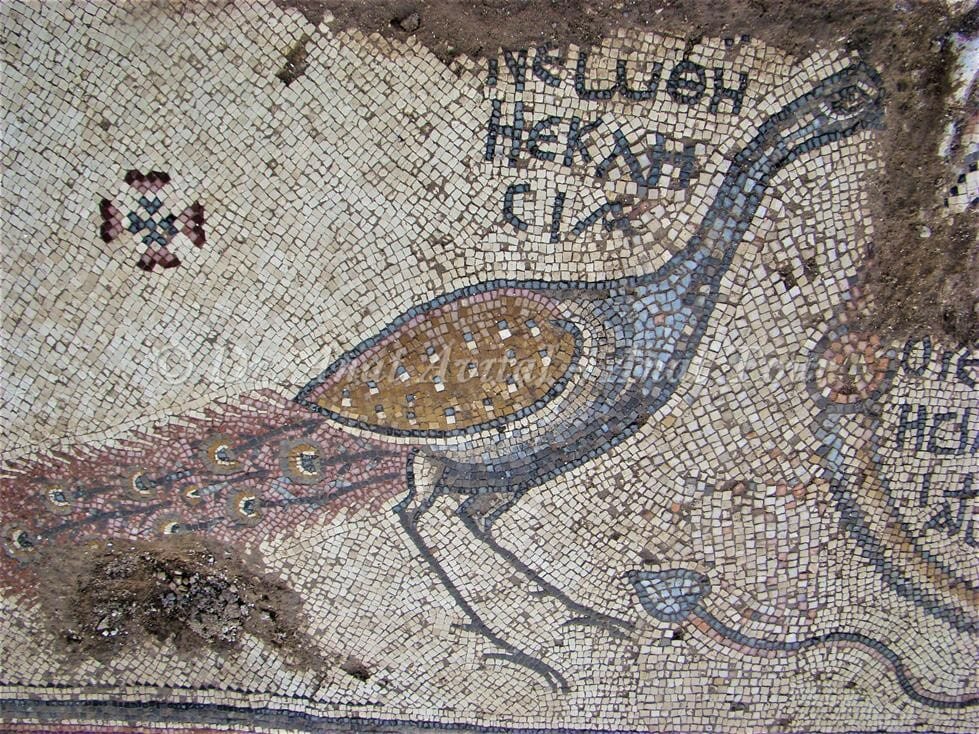
Among the bird decorations, the greatest number of decorations is of male peacocks (Fig. 1), and it is reasonable that the choice of the male stems from its qualities of beauty and its impressive size, and from its flesh being a prestigious delicacy of the wealthy. The peacock was domesticated for food, and its beautiful feathers served for ornament.
The pheasant was found in a total of 14 mosaics throughout Israel. 78% of them decorated Christian buildings, 14% decorated Jewish buildings and 7% Roman buildings, in a distribution almost identical to that of all the mosaics. Here too only the males were designed, probably for the same reasons for which the male peacocks were chosen.
The bird next in frequency of occurrence after the peacock in the mosaics of Israel is the chukar partridge, which, as mentioned, symbolizes evil in Christianity. Yet it is decorated with great beauty and charm among other birds, without special emphasis on its appearance. The partridge decorates a total of 19 mosaics throughout the Land of Israel: 15 occurrences in mosaics of Christian buildings (79%), two occurrences in Jewish buildings (10.5%) and two in Roman buildings (10.5%). Thus precisely the partridge, which symbolizes evil in Christianity, is displayed with a slight numerical advantage in Christian mosaics, in complete contrast to the charming message of the mosaics, which convey a viewing experience of wealth, comfort and prosperity.
The helmeted guineafowl is also a relatively large bird, pleasant in appearance, with soft and tasty flesh, which was domesticated for food, ornament and guarding (Bartov 1990: 256). In total, 13 mosaics with decorations of guineafowl were found throughout the country, 70% of them in buildings associated with the Christian inhabitants of the country and 30% in buildings associated with its Jewish inhabitants. Despite the high percentage of occurrences of guineafowl in mosaics in Jewish buildings, no symbolic connection to guineafowl decorations is known in the ancient Jewish sources, and it is not mentioned in the Bible, the Mishnah or the Talmud.
The rock dove, which in Christianity symbolizes repentance, decorates a total of 12 mosaics throughout the Land of Israel: 75% of them in buildings of the Christian inhabitants of the country – in a ratio identical to the general number of mosaics from the Christian sector – 8.5% in buildings that served the Jewish inhabitants, and 16.5% in buildings that served the Roman inhabitants of the country, who showed a strong affinity for dove decorations.9 Therefore, on grounds of the distribution of the illustrations and for further reasons that will be clarified below, in this article we shall treat the depictions of birds in the context of their natural distribution, hunting and captivity, domestication, economy and agriculture, and not in their symbolic-religious context.10
The mosaic as a reliable representative of ancient reality
The mosaic serves as an important historical document. The figurative designs contribute much to our acquaintance with the life of the period (Ovadiah 1993: 7–13), and one can learn from them about society, culture, agriculture, economy and religion. The data emerging from the mosaic are no less important than the written data of the period (Avital 2014a; 2014b; Gootwine 2016; Bowersock 2006). Modern research recognizes the importance of the visual documentation of the plastic arts and uses this documentation as evidence from the past in combination with a variety of evidence from ancient literature, archaeology, history and philology (Janick, Paris and Parrish 2007: 1452–1453; Zohary, Hopf and Weiss 2012: 142–143; Avital and Paris 2014).
Documenting the concern for food
In antiquity people had several main primary concerns, and they demanded daily attention. One of them is the supply of water and food. The production of high-quality, nourishing, fresh and tasty food always required effort, technology and developing agricultural methods. These efforts, and the economic challenge of supplying high-quality food to the inhabitants of the place, appear to be the main reason why the patrons of the buildings harnessed the mosaics to convey messages and to depict fine agricultural produce reflecting the attainment of these goals. Thus, for example, the mosaics succeed to this day, by means of original and splendid designs, in drawing much attention to the cultivation of choice fruits (Avital 2014a: 94–117) and to the display of agro-technological activities of pruning and grafting advanced for their time (ibid.: 202–230). The mosaics also give impressive expression to the ability to supply food from animals by means of activities such as hunting and fishing, alongside depictions of captivity, domestication and the agricultural raising of mammals and birds (Fig. 2).
The birds in the mosaics
The difficulty in illustrating birds in mosaic stems from the great similarity between the different species, the scarcity of identifying details, the relatively small size of the birds, and the need to keep a proportional framework for a small bird beside the larger elements of the mosaic – all this, as mentioned, in addition to the other challenges facing the creators: assembling the stones, matching the colours and creating a resolution that would give meaning to the picture. In addition, calculations of perspective and composition were made in order to prevent distortions or grotesque depictions. Thanks to all this the mosaics were endowed with a lively and credible power of expression, and still today they create a pleasant viewing experience faithful to reality.
The difficulty of identifying birds – in reality and in the mosaic
The difficulty in identifying birds stems from the great fear of birds of man and from the minimal distance at which they allow themselves to remain in place before spreading their wings and fleeing. The small size of the birds and the viewing distance from them also make identification difficult, since in most cases the birds are in flight and their movement is fast. It is important to note that there is great similarity between the different bird species, and sometimes only expert ornithologists can distinguish between some species of birds in reality, let alone in a mosaic.
The features that identify the bird species and distinguish between them are: the size of the bird, the colours of its plumage, its body structure and proportions, the kind of food it eats, the structure and colours of its bill, the structure and posture of its head and neck, the shape and position of its eyes, the shape, length and colour of its legs, the shape and position of its toes, and the shape and colours of its tail and wings. In the eye of the ornithologist each bird species also has a unique ethological character: unique body displays and postures, unique flight, a characteristic manner of walking or hopping, environment and habitat, particular habits of eating and drinking, social gathering or individual behaviour, and other characteristic behaviours that distinguish between the various birds. The illustrations of birds in the mosaics show some of these characteristics, and they contribute much to the identification of the species. In cases of difficulty in identifying the species of a bird in a mosaic because of an inaccurate or unclear illustration, one can rely on ethological characteristics and body postures and propose an identification and assignment at the level of the genus or family of the bird.
Identification of birds in live observations is usually done today by means of binoculars or telescopes, and also by deciphering high-quality videos – means that did not exist in the past. It is therefore reasonable that the planners of the designs and the creators of the mosaics observed birds as models mainly while they were held in captivity. The precision in detailing the identifying features of the various bird species in the mosaics shows direct viewing by the creators of birds that were before them, or of motionless stuffed specimens (Dr. Oren Hasson, oral communication). A thorough and meticulous study of the depictions of birds in the mosaics shows that the creators of the designs studied the identifying details of the birds, knew the different species well and succeeded in rendering their figures precisely, despite the objective difficulty involved in painting with mosaic stones.
Design of birds while standing and not in flight
It can be determined that in almost all the mosaics of the Byzantine period the birds were depicted in postures of standing or walking and not in flight (Fig. 3). Only in a tiny number of mosaics are the birds shown in flight. For example, a dove and other birds were designed in flight in the mosaic of the Great Palace of Constantine in Istanbul, dated to the sixth century CE (Yücel 2010: 34–35, 78–79), and ducks spreading their wings in flight from a bearded vulture trained for falconry hunting were depicted in the Falconer’s mosaic from Argos in the Peloponnese (Akerström-Hougen 1974).
The reasons for designing the birds at rest stem from several factors, on the practical plane and on the plane of the message to the viewers. The most trivial and practical reason is that it is very difficult to identify birds in flight at a distance. It is also more convenient to identify a bird, both in a picture and in reality, when it is standing and not while it is flying. The illustrations, which were intended for the eyes of the viewers, presented designs with the greatest number of characteristics that would help the observer identify the bird. This appears to be an important detail that helps to decipher the purpose of the depictions in the mosaics, namely the wish to express man’s control over nature and to display it for all to see: the acquaintance with the birds – their hunting, capture, taming, domestication and exploitation for human needs. Similar conclusions emerged from the study of the depictions of agricultural tools and crops documented in the mosaic works (Avital 2014a; 2014b).
Sexual dimorphism: wider artistic expression of designs of male birds
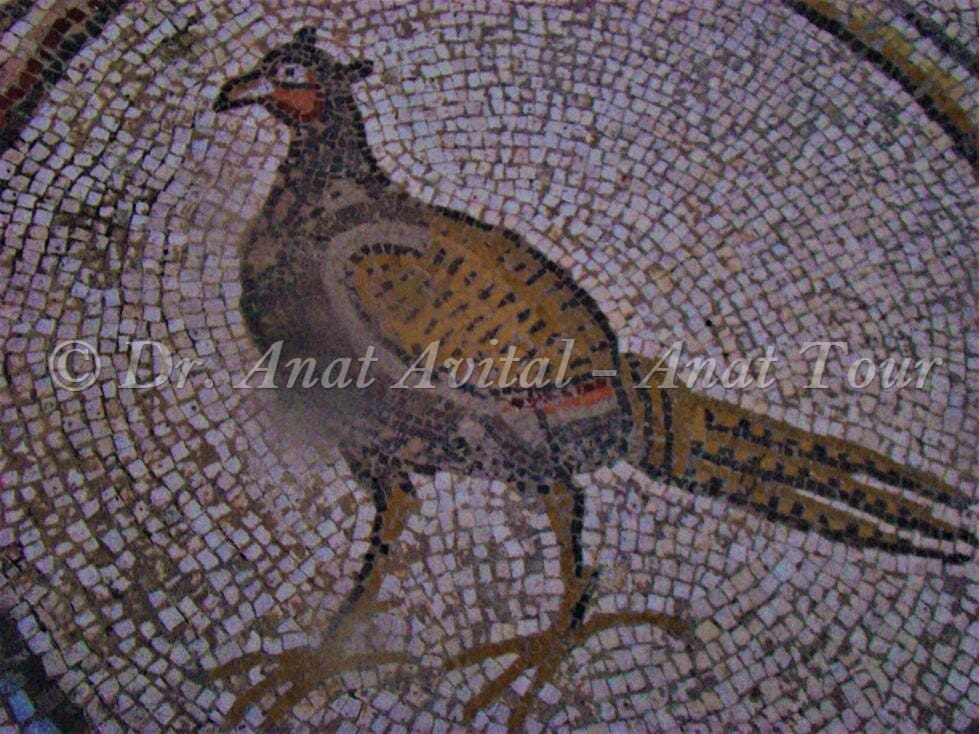
In many bird species the difference between the sexes is prominent, and the male can clearly be distinguished from the female. In mosaics decorated with species with sexual dimorphism, a preference for depictions of males was evident. Twenty-six designs of males of six bird species with sexual dimorphism were documented in the mosaics in Judea, Samaria and the Sharon, compared with 6 females11 (without counting repeated appearances in the same mosaic). It is reasonable to assume that the decision of the designers to depict mainly males in the mosaics stemmed both from considerations of beauty, since the males are more colourful and more attractive to the eye, and from the need to show distinct marks for identifying the species of the bird while giving realistic visual expression. Usually, when there is a visual difference between the sexes, the males have colourful plumage by which they impress and stand out in the natural or agricultural landscape, and sometimes they are even larger than the females, in accordance with the handicap principle (Grafen 1990). The females, by contrast, have plumage in pale, brown, grey, inconspicuous and camouflaged colours, for example in the common pheasant (Fig. 4).
The artisans used the physical qualities of the males to allow a clear definition of the species of the bird, and thus they were able to serve the main purposes of the mosaic – impressive and colourful illustrations, and the conveying of a visual message that is catchy, comprehensible and familiar to the viewer.
The bird species that decorated mosaics in Judea, Samaria and the Sharon
Thirty-four bird species were identified in the mosaics in Judea, Samaria and the Sharon (Table 1),12 and among them are several bird species whose appearance in the mosaics arouses interest and curiosity. The finding that emerged is especially fascinating, and it can help to solve the riddle of the motives and reasons for choosing these birds for display on the mosaic floors. The discussion here concerns only those birds that were designed precisely and realistically, and whose identification is certain or nearly certain.
In addition to them, birds were identified that could be defined systematically only at the level of the family or order: dove, duck, songbirds and some diurnal birds of prey. These birds belong to the family Columbidae, to the family Anatidae, to the order of songbirds (Passeriformes) and to the order of diurnal birds of prey (Accipitriformes), to which the birds of the family Accipitridae belong. The fact that most of the birds can be identified at the level of the species shows the high ability of the creators of the mosaics and their close observation of the details of live birds. The investment in precise and realistic depictions also illuminates the importance of the mosaic as a means of conveying a cultural and economic message from the patrons of the building to its visitors.
Table 1: The 34 bird species shown in mosaics in Judea, Samaria and the Sharon, according to their distribution characteristics
| Bird | Scientific name | Group | Mosaic sites | Total |
|---|---|---|---|---|
| Common pochard | Aythya ferina | Nilotic | Horvat Midras – church | 1 |
| House sparrow | Passer domesticus | Resident | Lod – villa | 1 |
| Gull | Larus | Resident | Lod – villa | 1 |
| Great tit | Parus major | Resident | Lod – villa | 1 |
| Glossy ibis | Plegadis falcinellus | Winter visitor | Beit Loya – church | 1 |
| Hooded crow | Corvus cornix | Resident | Beit Sila – Church of St. Theodore | 1 |
| Eurasian hoopoe | Upupa epops | Resident | Jerusalem – Church of St. John the Baptist | 1 |
| Common quail | Coturnix coturnix | Passage migrant | Jerusalem – Armenian burial chapel, 18 Ha-Nevi’im St. | 1 |
| Bearded vulture | Gypaetus barbatus | Domesticated | Jerusalem – Orpheus mosaic, burial chapel | 1 |
| Eurasian collared dove | Streptopelia decaocto | Resident | Jerusalem – Armenian burial chapel, 18 Ha-Nevi’im St. | 1 |
| Golden eagle | Aquila chrysaetos | Domesticated | Jerusalem – Armenian burial chapel, 18 Ha-Nevi’im St. | 1 |
| Black francolin | Francolinus francolinus | Resident | Caesarea – Palace of the Bird Mosaic | 1 |
| Mallard | Anas platyrhynchos | Winter visitor | Caesarea – Palace of the Bird Mosaic | 1 |
| Sandpiper (genus) | Tringa | Nilotic | Emmaus – church | 1 |
| Ostrich | Struthio camelus | Resident | Caesarea – Palace of the Bird Mosaic | 1 |
| Great white pelican | Pelecanus onocrotalus | Passage migrant | Caesarea – Palace of the Bird Mosaic | 1 |
| Domestic goose | Anser anser domesticus | Domesticated | Caesarea – mosaic in the buildings of Area CV, west of the vaults | 1 |
| Black stork | Ciconia nigra | Passage migrant | Beit Guvrin – Bird Mosaic; Beit Loya – church | 2 |
| Grey heron | Ardea cinerea | Winter visitor | Jerusalem – Church of St. John the Baptist; Jerusalem – Armenian burial chapel, 18 Ha-Nevi’im St. | 2 |
| Common blackbird | Turdus merula | Resident | Jerusalem – Church of St. John the Baptist; Caesarea – Mosaic of the Ibexes | 2 |
| Pied avocet | Recurvirostra avosetta | Passage migrant | Beit Guvrin – Bird Mosaic; Caesarea – mosaic in the buildings of Area CV, west of the vaults | 2 |
| White-spectacled bulbul | Pycnonotus xanthopygos | Resident | Jerusalem – Church of St. John the Baptist; Caesarea – Mosaic of the Ibexes | 2 |
| Grey-headed swamphen | Porphyrio poliocephalus | Resident | Jerusalem – Orpheus mosaic, burial chapel in Musrara; Jerusalem – Armenian burial chapel, 18 Ha-Nevi’im St.; Caesarea – Palace of the Bird Mosaic | 3 |
| Rose-ringed parakeet | Psittacula krameri | Domesticated | Berachot – church; Jerusalem – Orpheus mosaic, burial chapel in Musrara; Jerusalem – Church of St. John the Baptist | 3 |
| Laughing dove | Spilopelia senegalensis | Resident | Aluma – church; Emmaus – church; Jerusalem – Church of St. John the Baptist; Jerusalem – Armenian burial chapel, 18 Ha-Nevi’im St. | 4 |
| Helmeted guineafowl | Numida meleagris | Domesticated | Jerusalem – Orpheus mosaic, burial chapel in Musrara; Jerusalem – Church of St. John the Baptist; Ma’ale Adummim – Monastery of Martyrius (Khirbet el-Murassas); Caesarea – Palace of the Bird Mosaic | 4 |
| White stork | Ciconia ciconia | Passage migrant (4); Nilotic (1) | Aluma – church; Emmaus – church; Beit Loya – church; Jerusalem – Armenian burial chapel, 18 Ha-Nevi’im St.; Mevo Modi’im – chapel | 5 |
| Greater flamingo | Phoenicopterus | Passage migrant | Beit Loya – church; Beit Sila – Church of St. Theodore; Jerusalem – Church of St. John the Baptist; Jerusalem – Armenian burial chapel, 18 Ha-Nevi’im St.; Caesarea – Palace of the Bird Mosaic | 5 |
| Rock dove | Columba livia | Resident | Beit Guvrin – Bird Mosaic; Bethlehem – Church of the Nativity; Jerusalem – Church of St. John the Baptist; Jerusalem – Armenian burial chapel, 18 Ha-Nevi’im St.; Lod – villa | 5 |
| Common pheasant | Phasianus colchicus | Domesticated | Aluma – church; Beit Guvrin – Bird Mosaic; Beit Guvrin – Maḥat el-‘Urdi; Beit Loya – church; Jerusalem – Armenian burial chapel, 18 Ha-Nevi’im St.; Caesarea – Palace of the Bird Mosaic; Caesarea – Mosaic of the Ibexes | 7 |
| Chukar partridge | Alectoris chukar | Resident | Aluma – church; Beit Guvrin – Bird Mosaic; Bethlehem – Church of the Nativity; Beit Sila – Church of St. Theodore; Jerusalem – Church of St. John the Baptist; Jerusalem – Armenian burial chapel, 18 Ha-Nevi’im St.; Lod – villa; Horvat Midras – church | 8 |
| Indian peafowl | Pavo cristatus | Domesticated | Aluma – church; Beit Guvrin – Bird Mosaic; Beit Guvrin – Maḥat el-‘Urdi; Jerusalem – Armenian burial chapel, 18 Ha-Nevi’im St.; Lod – villa; Horvat Midras – church; En Gedi – synagogue (2); Caesarea – Palace of the Bird Mosaic; Kiryot (southern Hebron Hills) | 10 |
| Egyptian goose | Alopochen aegyptiaca | Domesticated (9); Nilotic (1) | Beit Guvrin – Bird Mosaic; Hadid; Jerusalem – Orpheus mosaic, burial chapel in Musrara; Jerusalem – Russian Church of the Ascension, chapel; Jerusalem – Church of St. John the Baptist; Jerusalem – Armenian burial chapel, 18 Ha-Nevi’im St.; Lod – villa; Horvat Midras – church; Caesarea – Palace of the Bird Mosaic; Caesarea – mosaic in the buildings of Area CV, west of the vaults | 10 |
| Domestic chicken | Gallus gallus domesticus | Domesticated | Aluma – church; Beit Loya – church; Bethlehem – Church of the Nativity; Jerusalem – Armenian burial chapel, 18 Ha-Nevi’im St. (2); Lod – villa (2); Horvat Midras – church; Ma’ale Adummim – Monastery of Martyrius (Khirbet el-Murassas); Caesarea – mosaic in the buildings of Area CV, west of the vaults; Caesarea – Mosaic of the Ibexes | 11 |
| Total – domesticated 47; resident 32; passage migrants 15; Nilotic 4; winter visitors 4 | 102 | |||
Distribution groups of the birds: domesticated, resident and migratory
Of the 102 occurrences of birds in the mosaics in Judea, Samaria and the Sharon, without counting repetitions in the same mosaic, almost half of the occurrences counted are of domesticated birds, birds in captivity or birds used for human benefit (47).13 A third of the species are resident wild birds (32). A minority of the birds are migratory: 15 passage migrants, 4 winter visitors and 4 depicting the landscapes of the Nile.14
Domesticated birds


Almost half of the birds decorating the mosaics are domesticated birds, and it is reasonable that the primary reason for choosing them was practical, since they were very common in animal husbandry and available to the eyes of the creators of the designs. The emphasis on depictions of domesticated birds also fits well with the insight that one of the important purposes of the mosaics was to display the economic prosperity of the local community. In this way the strong wish was expressed to show good acquaintance with the surrounding nature and the advanced abilities for its economic exploitation; pride in agricultural achievements; the ability to protect the agricultural crops, the animals and the plants; and the ability to establish a rich life and a strong, developed and diversified economy. The display of power and control was intended to glorify the patrons of the building and to impress the viewers with their developed abilities. In this way, as mentioned, the varied and beautiful field crops and the blessed fruit trees were also displayed, and advanced agro-technological activities of the Byzantine period were documented (Avital 2014a; 2014b).
Wild birds were hunted and raised in captivity already in early periods, and the beginning of the domestication and cultivation of bird species began about 5,000 years ago (Bartov 1990: 251–252; Dor 1997: 125–126). In fact, the bird species that man domesticated are not many, and evidence of this is evident in the mosaic decorations. Nevertheless, the contribution of the mosaics to documenting ancient agriculture is important, since an interesting reality and attempts at domesticating species that are no longer in commercial agricultural use today are portrayed in them. Birds that do not occur in the wild in Israel were also decorated in the mosaics, and it is therefore clear that they were brought here in antiquity by man for his benefit. During the history of domestication man stopped breeding uneconomic species and improved only economic species of birds, and today only a few species remain that are bred in agriculture to this day: the chicken, the goose, the duck and the ostrich.
The group of domesticated birds identified in the mosaics of Judea and Samaria includes 11 identifiable species, arranged by frequency from highest to lowest: Indian peafowl, domestic chicken, common pheasant, rock dove,15 helmeted guineafowl, Egyptian goose, rose-ringed parakeet, golden eagle,16 domestic goose, ostrich,17 bearded vulture and further diurnal birds of prey whose species cannot be identified. Most of the species were used for producing meat and eggs for food, for ornament and for a variety of uses of their feathers and skin, while their droppings were exploited for manuring the fields. In some species a special use was also made:
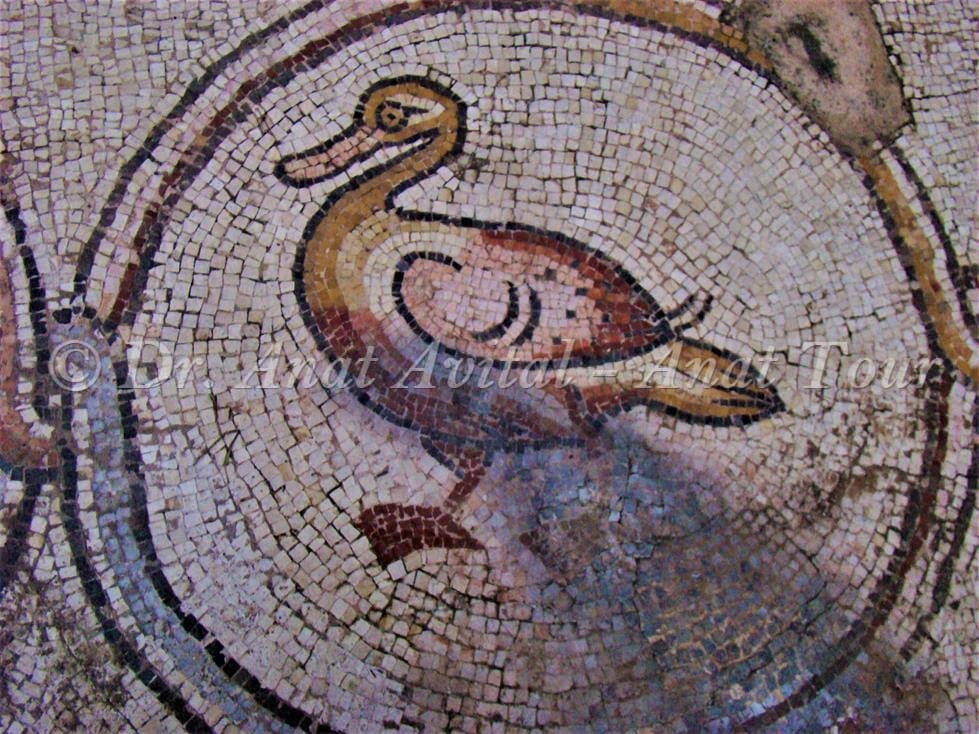
The domestic goose (Fig. 5) was domesticated about 5,000 years ago from the greylag goose (Fig. 6) and the swan goose, which lived throughout Europe, Asia and Africa. It was domesticated for food (meat and eggs), and its feathers were used for filling bedding and for making pens. Clothes were sewn from its skin, while its droppings were used for manuring the fields. Geese were also used for threshing and guarding (Bartov 1990: 257–258; Dor 1997: 125–126).
The rose-ringed parakeet is a handsome greenish parrot species originating in South Asia. The parakeet was brought to Alexandria by the generals of Alexander the Great (Paz 1993a: 272–273), and in antiquity it served as a cage bird that excelled in song and imitation (Ovidius 1599, 2.6). Parrots were used for play, for ornament and as cooked food for people, and also served as food for predators in captivity. In the occurrences of the parakeet in Israel it was designed in a greenish colour18 (despite the rarity of green stones) with a ribbon tied around its neck (Figs. 7–8). Its greenish colour and the unique ribbon on its neck are its distinguishing mark, and they distinguish it from the other birds. The design of the thick, short bill, hooked at the tip of its upper part, which is used for cracking seeds and peeling fruits and is characteristic of the Psittaciformes, also helps to identify the illustrated bird with the parakeet. A pair of parakeets, symbolizing the summer season, are designed in a Roman mosaic harnessed to a miniature carriage holding work tools of the summer season (Boehrer 2010: 14–20). A parakeet also decorates several mosaics of the fifth and sixth centuries in Antioch, in some of them appearing with a ribbon tied around its neck (Cimok 2000: 86, 96, 288–293). The distribution of the occurrences of parakeets in Roman and Byzantine mosaics from the Land of Israel, Turkey and Italy, as far as the Bird Mosaic from Italica in Spain (Raddato 2016), shows their wide use in culture and in human captivity.
The helmeted guineafowl (Fig. 9) was brought to Israel from Africa south of the Sahara and was raised in captivity for food (meat and eggs), for ornament and also for guarding (Bartov 1990: 256). The guineafowl is among the commonest birds in the mosaics,19 and it is easy to identify thanks to its rounded body shape, the white spots on the black background of its plumage, and the protruding casque on its head, which is the source of its name. Guineafowl are among the commonest domesticated birds in the mosaics after the pheasant, the chicken and the peacock.
The Indian peafowl was domesticated for food and ornament. Its feathers were used for decoration and its flesh was considered a delicacy served on the tables of the rich (Bartov 1990: 255–256). Today too the peacock serves as an ornamental bird throughout the world. The male peacock is very easy to identify in reality, as in the mosaic illustrations, because of its size and colourful plumage, its splendid tail and the crest on its head (Fig. 10).
The rock dove lives in the wild in Israel and also nests within settlements. Nevertheless, it is very appropriate to mention the rock dove among the domesticated birds that were in wide use in antiquity. The rock dove was raised for food (meat and eggs) and for ornament, was offered as a sacrifice, and its droppings were used for manuring the fields (Bartov 1990: 260–262; Paz 1993b: 264–265). As is well known, many columbaria were found in Israel and its surroundings (Zissu and Kloner 2010), attesting to intensive raising of doves. The dove is familiar from the Israeli landscape and it is easy to identify in the mosaics because of its medium body size, its dark grey tail, the tips of its grey wing feathers covering the tail, and two black transverse bars across the wing when it is standing. The colourfulness of the neck feathers in green and purple also makes it easier to identify. Because of the difficulty in obtaining green and purple stones, the creators of the mosaics often used similar colours and were able to keep the correct impression of the species of the bird (Fig. 11).
The ostrich was a common wild bird in Israel, mainly in the Negev and along the coastal plain (Paz 1993c: 34). Concentrations of ostrich eggshells and decorated shells were found in archaeological excavations, also from prehistoric periods (Henry 1983). Evidence of the use of ostrich eggs shows the exploitation of ostriches by gathering eggs from ostriches living in the wild or from ostriches living in captivity. In a mosaic from the church at Petra in Transjordan a pair of ostriches is decorated, and between them stands a basket holding their large eggs, carefully arranged (Fig. 12). Ostrich eggs were used as containers and also for food and decoration. Ostrich meat was used for food and its feathers for ornament. The ostrich is classified here with the resident birds, although it may be assumed that ostriches were held in captivity already in antiquity for the exploitation of their eggs, meat and feathers, and that the wild species was probably also cultivated in conditions of captivity. The ostrich is the largest of the birds, and its body dimensions were also emphasized in the mosaics. Its legs were designed tall, muscular and thick, and they were well placed according to the realistic body shape of the ostrich. The other features of its body details did not escape the eyes of the designers of the mosaics either: its short tail, its long and bent neck, its small head, its thick bill and its prominent eyes.
Birds used for falconry
One of the unique branches of bird husbandry reflected in the mosaics is the profession of falconry. The bearded vulture, the golden eagle and further diurnal birds of prey were used as trained hunting birds in the ancient profession of falconry. The prestigious branch of falconry is characterized by unique training of diurnal birds of prey to hunt reptiles, birds and mammals. Depictions of falconry activity are reflected in mosaics of the Byzantine period in Israel and beyond, including the mosaics in Judea, Samaria and the Sharon. The identification of these expressions in the mosaic is fascinating, and in this article an identification of birds of the falconry branch in mosaics of the Land of Israel is made for the first time.
The identification of diurnal birds of prey in the mosaics of Israel with raptors trained for the art of falconry is made possible by several features. A prominent feature is a frontal posture of the bird of prey with partly spread wings, which is a posture characteristic of trained raptors, which stabilize their stance when tied to a perch or to the owner’s arm, or when they try to fly without success.20 They can also be identified by designs of a ribbon or collar on the bird’s neck from which hangs a round perforated bell or a pendant. Falconers used in the past, and in fact also today, to tie a bell on the neck and leg of their trained birds, so that they could be located by its ringing. Training a bird of prey requires understanding, patience, perseverance and professionalism. The daily training process begins from the hatching of the bird from the egg and does not stop throughout the bird’s life, because without daily training the bird will forget the practice and return to its nature. The training and maintenance of a raptor for falconry involve a long and very expensive professional practice, and falconers tried as far as possible to avoid the loss of the costly trained bird. Today it is customary to locate the birds by means of advanced electronic tracking devices,21 although even today there are still places where raptors can be seen with a bell on their neck and legs, for example in Pakistan.22
Interesting and detailed depictions of hunting by means of a bearded vulture trained for falconry alongside hunting dogs are seen in the mosaic of the Villa of the Falconer of the sixth century CE at Argos in the Peloponnese in Greece (Akerström-Hougen 1974). In this mosaic the hunting activity is presented as a serial story in a sequence of several frames, in “comics” style. In the first frame the falconer holds a trained bearded vulture resting on his left arm and the leash of a dog in his right hand (Fig. 13). In the next scene the bearded vulture swoops on a duck and seizes it, while two more ducks escape in flight, and the hunter arrives quickly from behind with a knife in his hand.
A further interesting depiction is found in the mosaic of the Great Palace of Constantine in Istanbul, dated to the sixth century CE (Yücel 2010: 28–29). Here two noble boys are seen riding on the back of a camel. On the left arm of the boy sitting in front stands a bird of prey, perhaps a kite. The documentation of falconers and of the hunting activity itself in visual art required buildings with wide floors, like the villas mentioned, as well as a great investment in finding talented artisans. It may be assumed that the patrons of the buildings were also required to pay high wages for executing these complicated works.
In two mosaics from the region of Judea a clear depiction of falconry emerges. In the Bird Mosaic from the villa of el-Maqerqesh at Beit Guvrin a diurnal bird of prey is depicted without the possibility of defining its species, and in the Orpheus mosaic from a burial chapel in Jerusalem a bearded vulture is depicted with a ribbon and a bell on its neck (Fig. 14).
The bearded vulture is one of the most impressive and surprising birds identified in the mosaics. Its main identifying marks are the feathers covering its legs down to its toes like a kind of trousers, the orange-ginger shade of its plumage, the hump-like back characteristic of vultures, and its dark wings and the black feathers at the front of its face like a beard, the source of its scientific name (barbatus). The bearded vulture belongs to the group of Old World vultures, and unlike the carrion-eating vultures it is known for its sophisticated methods of seizing and crushing its prey.
In these depictions in the mosaics of Israel the hunting activity itself is absent, and neither the hunters nor the prey were depicted. Nevertheless, in order to inform the viewer of the mosaic that falconry is a profession present within the settlement or under the patronage of the patrons of the building, care was taken to paint the birds of prey with a chain or collar bearing a round identification bell or a pendant.
Similar appearances of birds of prey in human captivity were also depicted in the western Negev. In the mosaic of the synagogue of Ma’on-Nirim an eagle is depicted with a collar on its neck, and there is no possibility of defining its species; in mosaics from Jordan too figures of birds of prey were observed, probably a black kite.23 Its tail is forked, its colours are in shades of light brown, its posture frontal with spread wings, and a ribbon is tied around its neck (Fig. 15).
In two further mosaics from Jerusalem diurnal birds of prey were designed with spread wings in a characteristic frontal posture. Because of the great similarity in figurative style, it may be assumed that hints of falconry are documented in them too:
- In the mosaic of the Armenian burial chapel in Jerusalem a golden eagle was probably designed (Fig. 16; Avi-Yonah 1933: 171–172).
- In the mosaic in the Church of Mount Zion, the “Dormition”, in Jerusalem an eagle was designed (Fig. 17; Vincent 1908: 406–409).
It should be noted that relative to the frequency of depictions of falconry in Israel, depictions from mosaics of other regions throughout the Byzantine Empire, west of Israel, are even rarer, and only very few depictions of birds trained for the art of falconry were designed in mosaics of the Byzantine period.
The art of falconry originated in the East, and its precise origin has not yet been found – whether in the Far East, the Near East or perhaps even the Middle East (Epstein 1943: 497). In Israel illustrated evidence of falconry can be found on the Yehud coin known as “the god on the chariot”, struck in Israel and dated to 360 BCE. On one side of the coin a god is depicted seated on a winged chariot, and on his arm stands a bird of prey (perhaps a falcon) with a tail split in two (Meshorer 1997: 11–13, 253, Pl. 3, coin 1). Further raptors, probably eagles, are decorated on many Yehud coins, but these cannot be connected with certainty to the art of falconry (Meshorer 1997: 254, Pl. 2).
Pliny the Elder mentioned the unique cooperation of people with hawks in Thrace. The hunters frightened the birds out of the thickets, and after the birds had caught their prey, the hunters shared the spoils of the hunt with the birds (Pliny the Elder 1855: 10, 10). The art of falconry is also mentioned in the Talmud (Babylonian Talmud, Sanhedrin 95a).
Today, in many countries in the world, mainly in the Arab Emirates, Pakistan and Afghanistan, falconry is considered an expensive and prestigious sport. In Western countries – for example Sweden, Canada, Germany and Poland – falconry is integrated into programmes for the rehabilitation of endangered raptor populations, sustainable conservation of rare species and the preservation of the knowledge and skills of the art of falconry.24 It should be noted that in Israel the art of falconry is forbidden by strict regulations of the Israel Nature and Parks Authority, as a local extension of the rules of the UN CITES convention (Ginosar 2015).
Resident birds
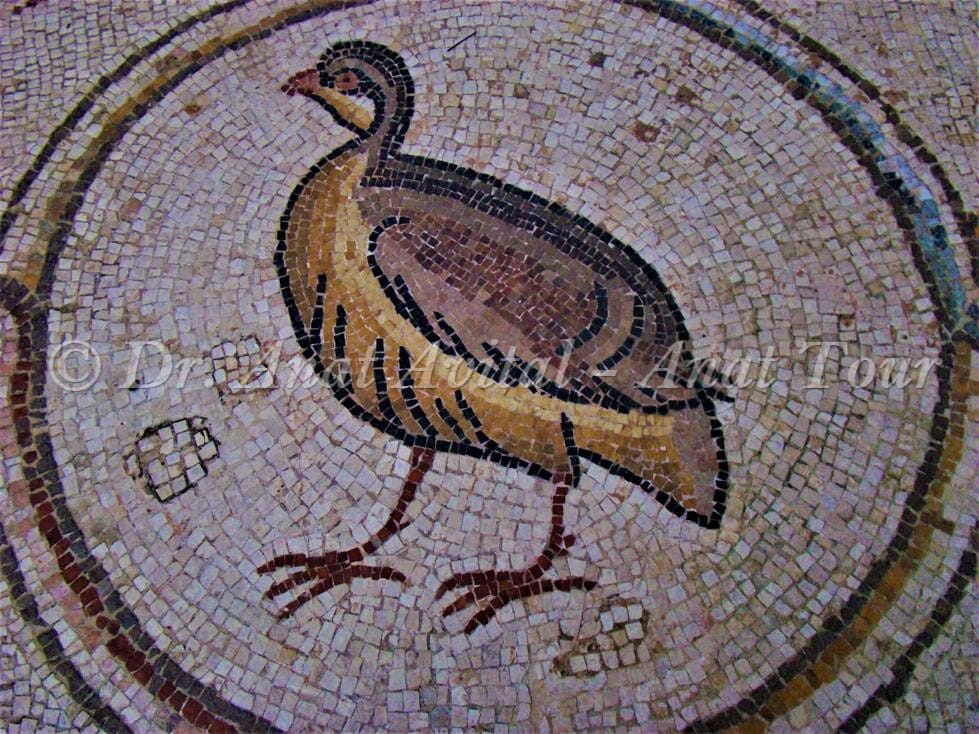
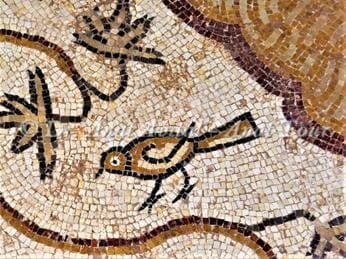
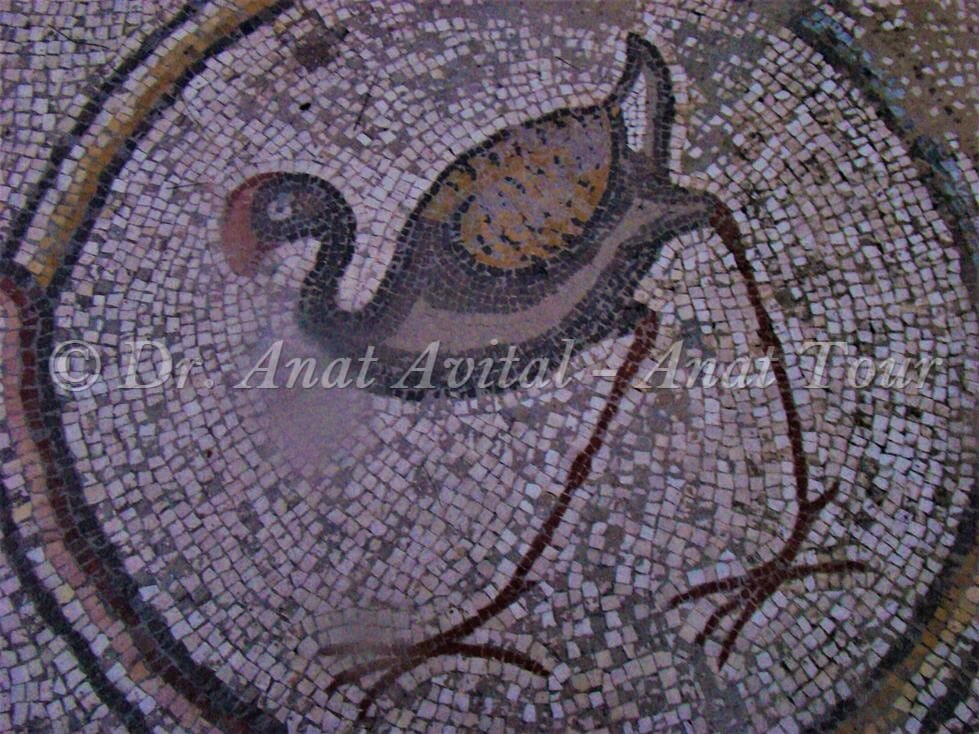
Resident birds are birds of species present in Israel throughout the year and which do not migrate. This group includes the following 14 bird species identified in the mosaics in Judea, Samaria and the Sharon, by their frequency in the mosaics, from highest to lowest: chukar partridge, rock dove, grey-headed swamphen, laughing dove, white-spectacled bulbul (Fig. 18), common blackbird, Eurasian hoopoe, Eurasian collared dove, black francolin (Fig. 19), hooded crow, ostrich, house sparrow, great tit25 and a bird of the gull family, probably a gull. In addition to them several songbirds were designed whose species cannot be identified.
Winter visitors
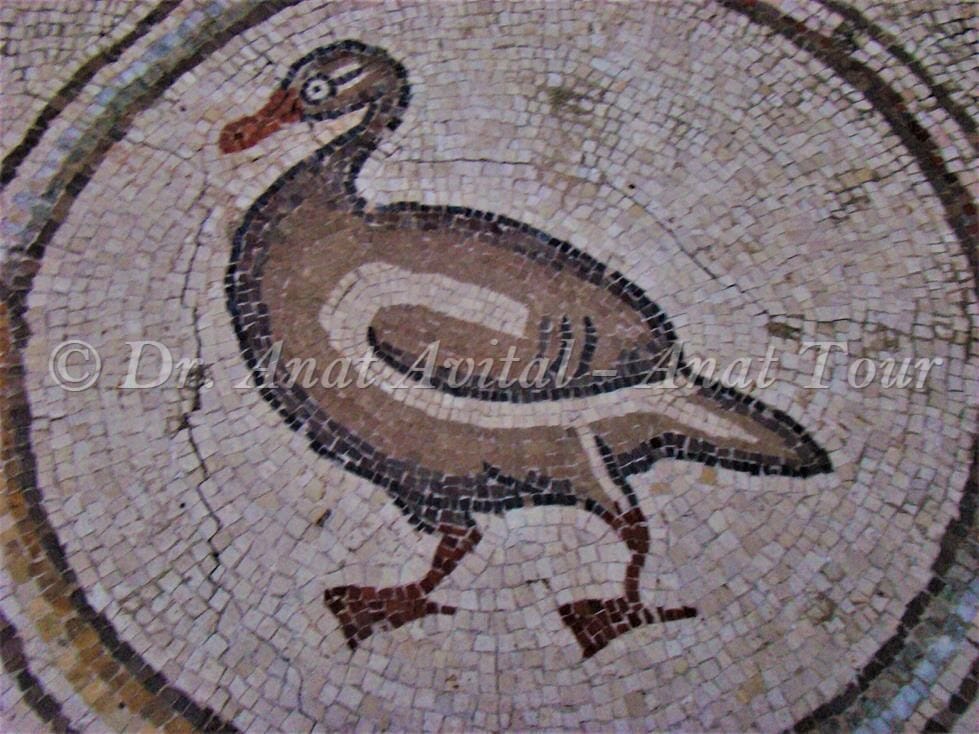
The group of winter visitors is the largest of the migratory birds in the Land of Israel. Many of the winter visitors visit Israel in flocks of thousands and tens of thousands of individuals. They arrive in Israel in autumn, spend the winter in Israel and leave again for their nesting countries in Europe and northern Asia. The group of winter visitors identified in the mosaics in Judea, Samaria and the Sharon includes three species: mallard, grey heron (Fig. 20) and glossy ibis.
Passage migrants
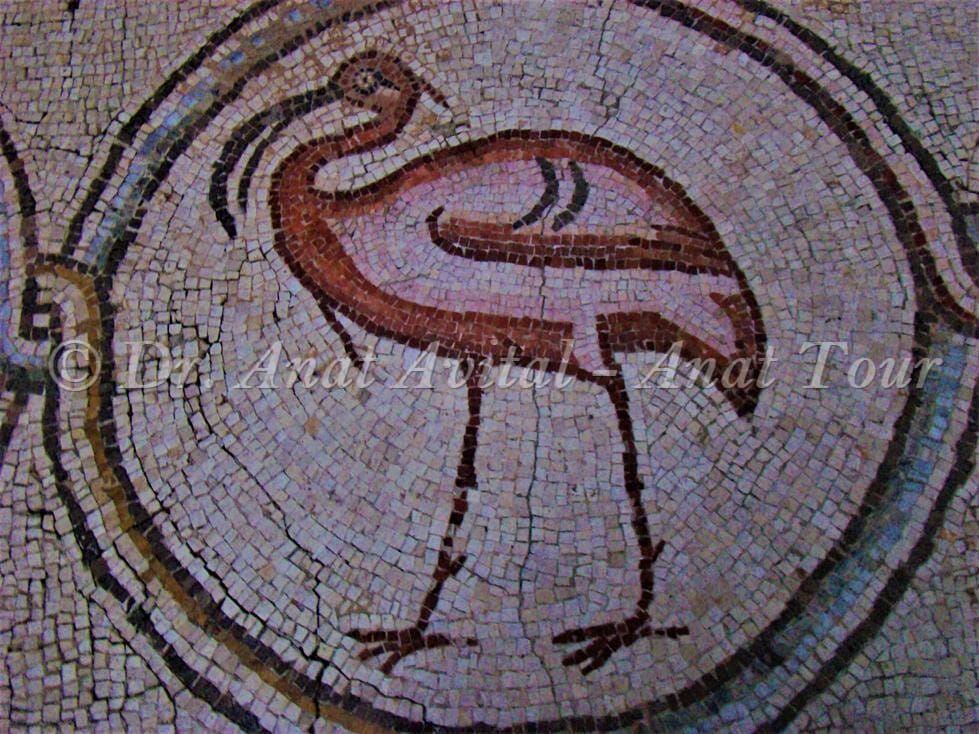
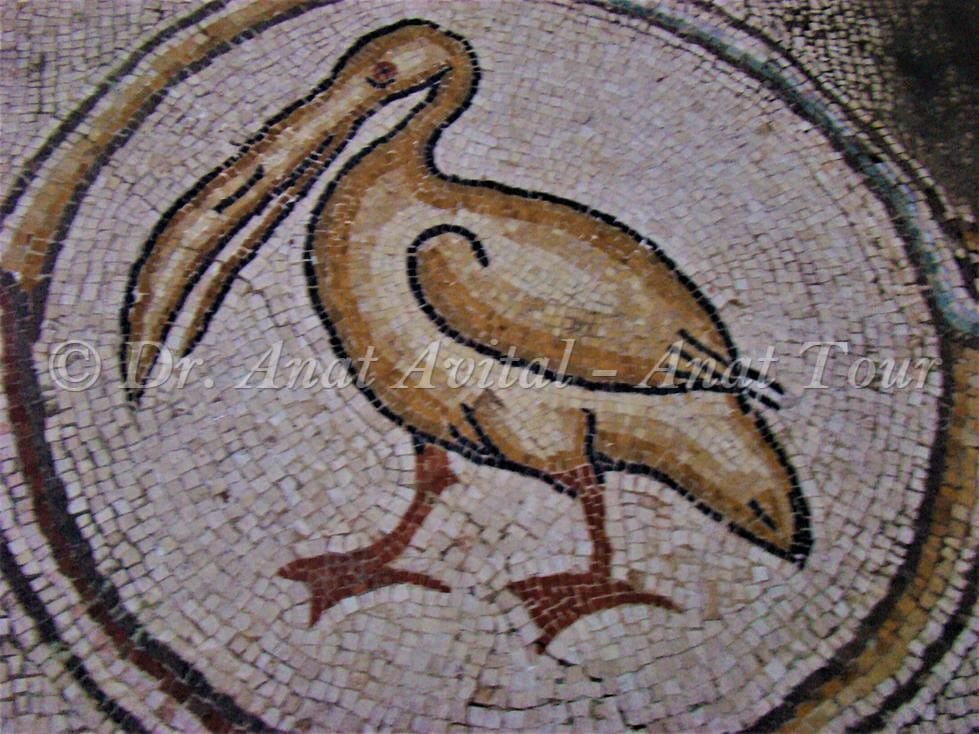

Passage migrants are transients in Israel. They pass through Israel during the autumn season on their way south from Europe to Africa, and in spring on their return north to their nesting sites. Some of the passage migrant species have individuals that remain to winter in Israel, and some species have representatives that even nest in Israel. Nevertheless, species most of whose individuals pass through were counted with the passage migrants because of the small number of individuals that remain in Israel to winter or nest, such as the white stork. The group of passage migrants identified in the mosaics of Judea and Samaria includes six species, in order of their frequency in the mosaics, from highest to lowest: greater flamingo (Fig. 21), white stork, black stork, pied avocet (Fig. 22), great white pelican and common quail.
Birds in a Nilotic context

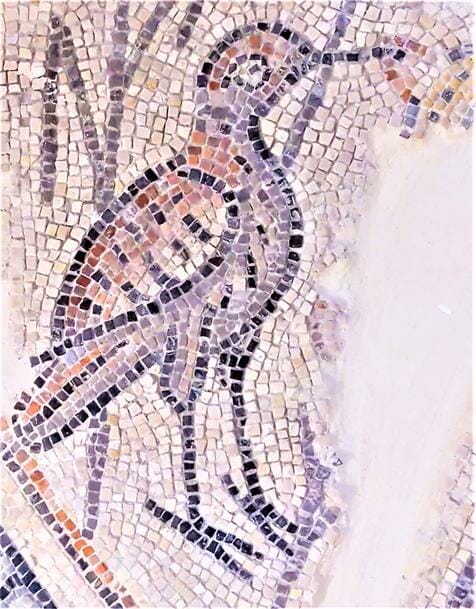
The birds decorated in a Nilotic context were designed in mosaics in which scenes of Nile life are represented, and in which lotus plants and other water plants, waterbirds and buildings depicting Egypt and Alexandria are combined. It should be noted that almost every mosaic in which depictions of Nile life are seen was accompanied by inscriptions helping to identify the place, or inscriptions helping to identify the species of animals that are not local to the site of the mosaic. The richest of all is the great Nile mosaic from Palestrina in Italy (Fig. 23; for more on it see Meyboom 1995). The group of Nilotic birds identified in the mosaics in Judea, Samaria and the Sharon includes five species: ducks whose species cannot be identified, white stork, sandpiper (Tringa), common pochard (Fig. 24)26 and Egyptian goose.
Summary
The need to identify the bird species, to define them and to understand their role in the composition of the mosaic became clear to me when I noticed that many bird species designed in the mosaics had not been identified in research at all. Some of them had been identified partially, wrongly or from the local view of the study of a single site, and there was an evident need to collect all the material in an overall study and to analyse the findings. In this study I examined the bird designs created in the mosaics found in Judea, Samaria and the Sharon in comparison with birds decorated in mosaics elsewhere in the Land of Israel and throughout the Byzantine Empire.
In the mosaics found in Judea, Samaria and the Sharon a total of 34 bird species are documented, and the species of most of them can be defined with certainty or with a great degree of certainty. In a small minority of the mosaics bird designs were created whose species could not be identified with certainty, and their identification was made only at the level of the family or order: dove, duck, songbirds and some diurnal birds of prey. The definition of this minority of birds suffered from the absence of high-quality pictures, partial destruction of the mosaic, an unclear depiction because of low resolution of the mosaic, or limited means of illustration available to the creators of the mosaic in designing the motif.
Even in cases where the creators of the mosaics had optimal tools and a large budget, there was always an objective difficulty in illustrating birds and in showing all the indicative details in the mosaic. The difficulty stemmed from a combination of several factors: the great similarity between bird species, the scarcity of details distinguishing between them, their relatively small size, the great timidity of birds, and the fact that they are mainly in flight (their main movement), as against the need to illustrate them while observing them standing or walking (that is, in conditions of captivity, or alternatively by viewing their stuffed specimens). The creators also faced challenges of matching the colours and size of the stones and of creating resolution, perspective, proportion and composition suitable for understanding the subject shown and for giving a viewing experience faithful to reality.
It may be said with great appreciation that the ancient creators of the mosaics knew the birds well and succeeded in classifying and presenting them in such a way that in most cases their species can be identified even today. Thus they succeeded in conveying to the eyes of the viewers the best identifying features accepted by ornithologists: size, colour, body structure, food preferences, the shape and colours of the bill, the structure and posture of the head and neck, the eyes and their position, the legs and their position, length and colour, the toes and their position, the shape of the tail and wings, their colours and arrangement, including unique postures and body displays, flight and habitat.
For a clear presentation of the bird species the artisans also made use of the means of identification of species with sexual dimorphism; those shown, impressive in their colourful plumage and body size, are the common pheasant, the Indian peafowl and the domestic chicken. Therefore, of the common pheasant only males were depicted, of the depictions of the Indian peafowl two females were depicted as against nine males, and of the depictions of the domestic chicken eight males were depicted as against only three females.
At the end of the identification and classification of the birds illustrated in the mosaics in Judea, Samaria and the Sharon, a total of 102 occurrences of birds were counted (without counting repetitions in the same mosaic). Almost half of them are domesticated birds (47); a third of the species are resident wild birds (32); and a minority of the birds are migratory: 15 passage migrants, 4 winter visitors and 4 depicting the landscapes of the Nile. In terms of the absolute number of species found in the mosaics of Judea, Samaria and the Sharon, 11 domesticated species, 14 resident species, 6 passage migrant species, 5 species in a Nilotic context and 3 winter visitor species were found.
The important place of birds in captivity and in cultivation for human benefit shows the wish to display the advanced agricultural and economic abilities, the ability to exploit wild birds, to control them and to identify species convenient for agricultural raising, as well as the satisfaction and pride in the very ability to produce food, to supply meat, eggs and feathers, and to exploit the droppings for manuring the fields. The display of the special birds used for falconry clearly reflects the spread of the art of training raptors in the Middle East and their use for hunting in Israel in the Byzantine period. The display of wild birds reflects the rich nature that surrounded the mosaic sites and the direct connection of people with the animal world. Many birds were hunted for human needs even if they were not suited to life in a cage, and in any case their display on the mosaic floors contributed to the colourfulness and beauty of the floors.
The mosaics served as a medium for conveying messages and information to the visitors to the buildings by means of figurative illustrations from mythology or from the Bible, and also by displaying a rich economy and a life of comfort. It seems that in the decorations of the ancient synagogues, the purpose of the rich decorations and of displaying economic ability and control over nature was also to represent a promise of a good life and economic abundance as a result of the worship of God and the observance of the commandments, prayer and study in the synagogues; in the decorations of the ancient churches the life of abundance relied on faith and on life under the patronage of the church and in loyalty to it. Local agriculture, the local fauna and flora, and the personal taste of those who commissioned the work, alongside their status and budgets, were a significant factor in the choice of motifs. In the mosaics found in villas of wealthy people and rulers one can gain an impression of the great wealth with which the owners were blessed, wealth well reflected in the detailed and realistic illustrations that the patrons of the building took the trouble to show to the viewers and visitors in their splendid mansions.
Notes
1. In this study I grouped the mosaics found in Judea, Samaria and the Sharon into a single research group.
2. Corresponding to the territories of the Byzantine provinces: Palaestina Prima west of the Jordan, Palaestina Secunda west of the Jordan, the southern part of Phoenicia and the northern part of Palaestina Tertia (Tsafrir, Di Segni and Green 1994: 15, Fig. 3; 17, Fig. 4).
3. This article is part of a more comprehensive study whose aim is to identify all the mammals and birds decorated in mosaics throughout the Land of Israel, and it is an important layer in completing the information that emerged from the study of agricultural crops and tools in the mosaics of the Land of Israel (Avital 2014a; 2014b).
4. Heinzel and Kafkafi 1975; Elphick and Woodward 2009; https://www.birds.org.il/he
5. The scenes from the House of Dionysos at Sepphoris (Talgam and Weiss 2004), for example, can be deciphered even from the distance of someone reclining on a couch!
6. Avi-Yonah catalogued them (Avi-Yonah 1933), and Ruth and Asher Ovadiah continued his work (Ovadiah and Ovadiah 1987).
7. 24 mosaic sites throughout the country in which a design of an Indian peafowl was found – 17 from the Christian sector: Aluma, Be’er Shema, Beit Guvrin, Maḥat el-‘Urdi, Beit Lehem HaGlilit, Beth She’an el-Hammam, Beth She’an – Monastery of Lady Mary, Bassul, Horvat Gerarit, Jerusalem – Armenian burial chapel, Horvat Midras, Mamshit – western church, Nahariya, Nahal Shiqma, ‘Ein Sheva (Tabgha), Caesarea – Palace of the Bird Mosaic, Kiryot (Hebron Hills), Shellal; five from the Jewish sector: Beth She’an – House of Leontis, Ma’on-Nirim, ‘Isfiya, Gaza, En Gedi; and two from the Roman sector: Beit Guvrin – Bird Mosaic, Lod.
8. All the photographs whose source is not noted beside them were taken by the author with the permission of those responsible for the mosaics: the excavators, the Israel Antiquities Authority, museums, churches or the Israel Nature and Parks Authority.
9. All the statistical data are held by the author of the article.
10. This study did not deal with such contexts and did not discuss them.
11. Black francolin, mallard, Negev ostrich, common pheasant, Indian peafowl, domestic chicken.
12. For comparison, forty bird species in total were identified in all the mosaics from all parts of the Land of Israel.
13. For convenience I have gathered them into one group, referred to below as “domesticated”.
14. This distribution is very similar to the finding from the other parts of the country: of 226 occurrences of identifiable bird species in mosaics from all parts of the Land of Israel (without counting repetitions in the same mosaic), almost half of the birds counted were domesticated (96). A third of the species counted are resident wild birds (72). A minority of the birds are migratory: 32 passage migrants, 9 winter visitors and 17 birds depicting the landscapes of the Nile.
15. The rock dove is a common resident wild species in Israel and also a domesticated species. In order not to count the species twice, the rock dove was counted in the table with the resident birds of Israel.
16. The eagle is counted in this article with the domesticated birds, because it is decorated in a spread-winged posture characteristic of a bird in captivity.
17. The ostrich was a common resident wild species in Israel and also a species that was probably held in captivity already in antiquity and exploited by man, as will be explained below. In order not to count the species twice, the ostrich was counted in the table with the resident birds of Israel.
18. Of course, the colours can be judged only in mosaics that are accessible today or of which authentic colour photographs exist.
19. The guineafowl was found decorated in four mosaics in Judea, Samaria and the Sharon, and in nine further mosaics in the other parts of the Land of Israel.
20. https://youtu.be/mAqw1mOCtN4, September 2021.
21. https://youtu.be/6sg7U6vCbng, September 2021.
22. https://youtu.be/nKYgA0LStdU, September 2021.
23. I thank Dr. Oren Hasson for the tentative identification.
24. The International Association for Falconry and Conservation of Birds of Prey (IAF) deals with nature conservation and with the preservation of the ancient art of falconry.
25. I thank Dr. Oren Hasson for help in identifying the house sparrow and the great tit.
26. I thank Dr. Oren Hasson for the help in identification.
References
Avital, A. 2014a. Crops and Agricultural Tools in Mosaics of the Late Roman and Byzantine Periods from the Land of Israel, research volume. PhD dissertation, Bar-Ilan University [Hebrew].
Avital, A. 2014b. Crops and Agricultural Tools in Mosaics of the Late Roman and Byzantine Periods from the Land of Israel, corpus volume. PhD dissertation, Bar-Ilan University [Hebrew].
Bartov, A. 1990. “Birds in the Farm.” In A. Alon (ed.), Plants and Animals of the Land of Israel: An Illustrated Encyclopedia, vol. 12. Tel Aviv: Ministry of Defence, pp. 251–262 [Hebrew].
Dor, M. 1997. Animals in the Days of the Bible, the Mishnah and the Talmud. Tel Aviv: Grafor-Daftal [Hebrew].
Faust, A. and Safrai, Z. 2015. The Settlement History of Ancient Israel: A Quantitative Analysis in Light of the Findings of Salvage and Planned Excavations. Ramat Gan: Ingeborg Rennert Center for Jerusalem Studies, Bar-Ilan University [Hebrew].
Ginosar, A. 2015. “Committed to Nature in the CITES Convention.” Bi-Shvil ha-Aretz: Magazine of Nature, Landscape and Heritage. Israel Nature and Parks Authority website, http://beshvilhaarez.parks.org.il/article.asp?item=40 [Hebrew].
Gootwine, E. 2016. The Appearance of Sheep in the Past According to the Archaeological Finds in Israel and its Neighbours, Mesopotamia and the Mediterranean Countries. Rehovot: Institute of Animal Science, Volcani Center [Hebrew].
Hachlili, R. 1987. “On the Problem of the School of Mosaicists in Gaza.” Eretz-Israel: Archaeological, Historical and Geographical Studies 19: 46–58 [Hebrew].
Heinzel, H. and Kafkafi, Y. 1975. The Birds: A Complete Field Guide to the Birds of Europe and the Middle East (trans. Y. Kafkafi; ill. H. Hermann). Tel Aviv: Hakibbutz Hameuchad [Hebrew].
Meshorer, Y. 1997. A Treasury of Jewish Coins: From the Persian Period to Bar Kokhba. Jerusalem: Yad Izhak Ben-Zvi [Hebrew].
Ovadiah, A. 1993. The Art of Mosaic in Ancient Synagogues in the Land of Israel: From the Fourth to the Seventh Century. Tel Aviv: University Gallery of Art [Hebrew].
Paz, U. 1993a. “Parakeet.” In A. Alon (ed.), Plants and Animals of the Land of Israel: An Illustrated Encyclopedia, vol. 6. Tel Aviv: Ministry of Defence, pp. 272–273 [Hebrew].
Paz, U. 1993b. “Rock Dove.” In A. Alon (ed.), Plants and Animals of the Land of Israel: An Illustrated Encyclopedia, vol. 6. Tel Aviv: Ministry of Defence, pp. 264–265 [Hebrew].
Paz, U. 1993c. “Ostrich.” In A. Alon (ed.), Plants and Animals of the Land of Israel: An Illustrated Encyclopedia, vol. 6. Tel Aviv: Ministry of Defence, pp. 34–35 [Hebrew].
Safrai, Z. 1997. “The Village in Judea.” In S. Dar and Z. Safrai (eds.), The Ancient Village in the Land of Israel. Tel Aviv: Eretz – Geographic Research and Publications, Tel Aviv University, pp. 11–74 [Hebrew].
Zissu, B. and Kloner, A. 2010. “Horvat Midras (Khirbet Durusiya): A Renewed Archaeological and Historical-Geographical Examination of the Settlement in the Late Second Temple Period and the Bar Kokhba Revolt.” New Studies on Jerusalem 16: 231–253 [Hebrew].
Akerström-Hougen, G. 1974. The Calendar and Hunting Mosaics of the Villa of the Falconer in Argos: A Study in Early Byzantine Iconography, Vol. I: Text; Vol. II: Plates. Stockholm: Swedish Institute in Athens.
Avi-Yonah, M. 1933. “Mosaic Pavements in Palestine.” QDAP 2: 136–181.
Avi-Yonah, M. 1934. “Mosaic Pavements in Palestine.” QDAP 3: 26–73.
Avital, A. and Paris, H. S. 2014. “Cucurbits Depicted in Byzantine Mosaics from Israel, 350–600 CE.” Annals of Botany 114(2): 203–222.
Boehrer, B. T. 2010. Parrot Culture: Our 2500-Year-Long Fascination with the World’s Most Talkative Bird. Philadelphia: University of Pennsylvania Press.
Bowersock, G. W. 2006. Mosaics as History: The Near East from Late Antiquity to Islam. Cambridge, MA: Belknap Press of Harvard University Press.
Cimok, F. (ed.). 2000. Antioch Mosaics: A Corpus. Istanbul: A Turizm Yayınları.
Dunbabin, K. M. D. 1999. Mosaics of the Greek and Roman World. Cambridge: Cambridge University Press.
Elphick, J. and Woodward, J. 2009. RSPB Pocket Birds of Britain and Europe. London: Dorling Kindersley.
Epstein, H. J. 1943. “The Origin and Earliest History of Falconry.” Isis 34(6): 497–509.
Grafen, A. 1990. “Biological Signals as Handicaps.” Journal of Theoretical Biology 144(4): 517–546.
Hachlili, R. 2009. Ancient Mosaic Pavements: Themes, Issues, and Trends. Leiden: Brill.
Henderson, P. H. 1985. The Shellal Mosaic in the Australian War Memorial: Style and Imagery. Fourth-year honours thesis, Australian National University.
Henry, D. O. 1983. “Rosh Zin: A Natufian Settlement Near Ein Avdat.” In A. E. Marks (ed.), Prehistory and Paleoenvironments in the Central Negev, Israel, Vol. I. Dallas: Southern Methodist University Press, pp. 317–347.
Janick, J., Paris, H. S. and Parrish, D. C. 2007. “The Cucurbits of Mediterranean Antiquity: Identification of Taxa from Ancient Images and Descriptions.” Annals of Botany 100: 1441–1457.
Meyboom, P. G. P. 1995. The Nile Mosaic of Palestrina: Early Evidence of Egyptian Religion in Italy. Leiden: Brill.
Ovadiah, R. and Ovadiah, A. 1987. Mosaic Pavements in Israel: Hellenistic, Roman and Early Byzantine. Rome: “L’Erma” di Bretschneider.
Ovidius, P. N. 1599. Amores (trans. C. Marlowe). Perseus Digital Library. http://www.perseus.tufts.edu/hopper/text?doc=Perseus%3atext%3a1999.03.0016
Piccirillo, M. 1993. The Mosaics of Jordan. Amman: American Center of Oriental Research.
Pliny the Elder. 1855. The Natural History (trans. J. Bostock and H. T. Riley). Perseus Digital Library. http://www.perseus.tufts.edu/hopper/text?doc=Perseus%3atext%3a1999.02.0137
Raddato, C. 2016. “Mosaics of Spain’s Roman Baetica Route: Italica.” http://etc.ancient.eu/travel/mosaics-roman-baetica-route-italica/
Safrai, Z. 2010. “Agriculture and Farming.” In C. Hezser (ed.), The Oxford Handbook of Jewish Daily Life in Roman Palestine. Oxford: Oxford University Press, pp. 246–263.
Talgam, R. and Weiss, Z. 2004. The Mosaics of the House of Dionysos at Sepphoris (Qedem 44). Jerusalem: Institute of Archaeology, Hebrew University of Jerusalem.
Trilling, J. 1989. “The Soul of the Empire: Style and Meaning in the Mosaic Pavement of the Byzantine Imperial Palace in Constantinople.” Dumbarton Oaks Papers 43: 27–72.
Tsafrir, Y., Di Segni, L. and Green, J. 1994. Tabula Imperii Romani, Iudaea – Palaestina: Eretz Israel in the Hellenistic, Roman and Byzantine Periods – Maps and Gazetteer. Jerusalem: Israel Academy of Sciences and Humanities.
Vincent, L. H. 1908. “Mosaïques byzantines, timbres romains, varia.” Revue Biblique 5(3): 406–415.
Weiss, E. and Kislev, M. E. 2007. “Plant Remains as a Tool for Reconstruction of the Past Environment, Economy, and Society: Archaeobotany in Israel.” Israel Journal of Earth Sciences 56: 163–173.
Yücel, E. 2010. Great Palace Mosaic Museum. Istanbul: A Turizm Yayınları.
Zohary, D., Hopf, M. and Weiss, E. 2012. Domestication of Plants in the Old World (4th ed.). Oxford: Oxford University Press.


